Software Requirement Specification Document Tips
Master the software requirement specification document with practical templates, AI workflows, and a checklist to prevent scope creep and project failure.
You're three sprints into a build when a stakeholder opens staging, clicks through the new workflow, and says, “That's not what I asked for.” The team has user stories, Slack threads, workshop notes, and a heroic collection of sticky notes. What it doesn't have is one reliable answer to the question, what exactly are we building, and how will we know it's correct?
A software requirement specification document, or SRS, answers that question. Done well, it gives product, engineering, design, QA, and stakeholders a shared reference before vague promises turn into expensive code. Done badly, it becomes a ceremonial Word file nobody opens after approval.
The practical shift is to stop treating the SRS as paperwork. Treat it as a living, traceable, AI-assisted product artifact that connects business intent to implementation, testing, and change decisions.
Why Your Last Project Failed and How an SRS Fixes It
The failure usually starts innocently. Someone says the application needs “a simple approval flow.” A designer sketches a screen, a developer interprets approval as a single status change, and QA prepares a happy-path test. Then a stakeholder asks what happens when two people approve at once, an approver loses access, or a request needs to be rejected with a reason.
Nobody was being careless. Everyone was filling in missing information from their own experience. That's how software projects drift. The product manager thinks “approval flow” describes a business process, the developer thinks it describes an endpoint, and the tester thinks it describes a test case. By the time the disagreement becomes visible, the team has already paid for several interpretations.

An SRS acts as a scope and interpretation control. It states the product's purpose, users, boundaries, functions, interfaces, constraints, quality expectations, and acceptance conditions. It also makes non-goals visible. “The system will allow a manager to approve a request” is incomplete until the document clarifies who counts as a manager, what data the manager can see, what happens after approval, and how the team validates the behavior.
Who should read the document
A useful SRS isn't written for developers alone. Each role uses it differently:
- Stakeholders confirm that the proposed behavior reflects the business need.
- Product managers use it to control scope and resolve competing priorities.
- Developers and architects turn requirements into designs and implementation tasks.
- Designers understand user roles, workflows, constraints, and edge cases.
- QA engineers derive test cases from verifiable statements.
- Project managers use dependencies and acceptance conditions to plan delivery.
The document should be readable enough for a stakeholder to challenge an assumption and precise enough for an engineer to implement a behavior without guessing. That balance is harder than making a document long. More pages don't cure ambiguity. Better decisions do.
Practical rule: If a requirement can't be explained to a stakeholder and tested by QA, it isn't finished.
Teams often try to solve this with more meetings. Meetings help with discovery, but they don't create a durable decision record by themselves. A concise, versioned SRS paired with sensible project management best practices gives the team somewhere to settle disagreements before they become refactors.
The Anatomy of a High Quality Specification
The SRS has been around far longer than the latest agile terminology. SRS documents were used in software development as early as 1975, and IEEE formally standardized the practice in 1983. The first guide was approved on September 30, 1983 and published on February 10, 1984 as IEEE 830-1984. IEEE revised the standard in 1993 and 1998, and ISO/IEC/IEEE 29148:2011 later superseded the requirements-engineering guidance, with a further update in 2018. This documented standards timeline shows a practice evolving over more than four decades, not a relic that agile teams can casually ignore.
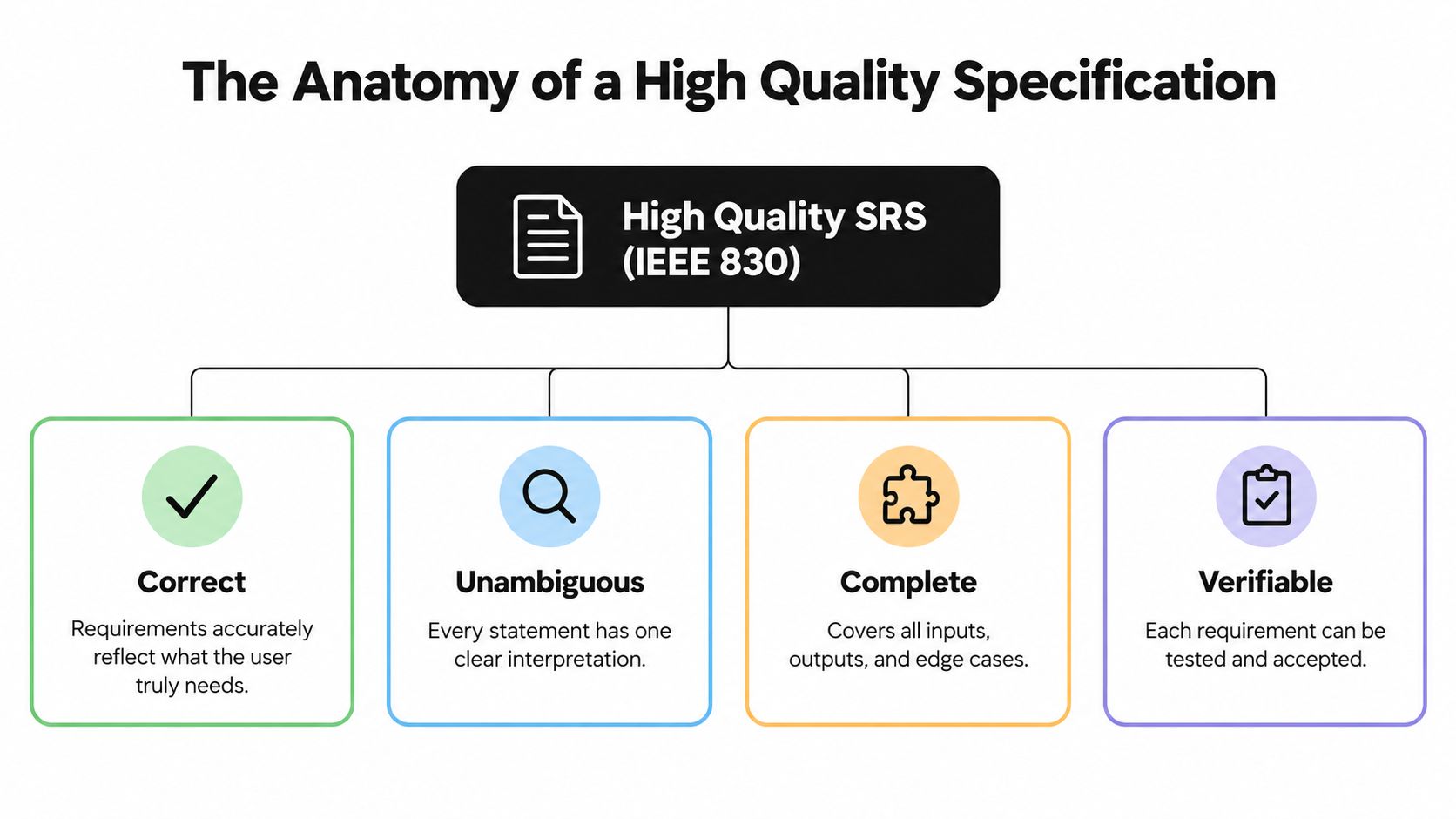
IEEE 830-1998 described eight core characteristics of a high-quality SRS:
- Correct, it reflects the actual need.
- Unambiguous, each statement has one reasonable interpretation.
- Complete, relevant requirements and responses aren't missing.
- Consistent, requirements don't contradict one another.
- Ranked, importance and stability are identified.
- Verifiable, testers can determine whether the requirement is met.
- Modifiable, changes can be made without wrecking the document.
- Traceable, each requirement has an identifiable origin and destination.
These qualities matter in an agile environment because short delivery cycles increase the cost of unclear decisions. A sprint can move quickly in the wrong direction. “Fast,” “intuitive,” and “secure” sound useful but don't tell anyone what to build or test. Replace them with observable conditions, defined actors, business rules, failure states, and acceptance criteria.
Traceability is the part teams skip
Traceability connects a requirement to its parent need and to the artifacts derived from it, such as designs, code changes, and tests. Bidirectional traceability works backward to the requirement's origin and forward to the documents or implementation that depend on it. IEEE guidance treats this as a core quality property, and NASA guidance requires bidirectional links between software requirements and related hazards or mitigations in relevant engineering contexts. The IEEE 830 reference explains the standard's traceability expectations, while NASA's software requirements guidance illustrates why traceability affects risk control, not just document tidiness.
A practical requirement record might include:
- Identifier: REQ-AUTH-014
- Source: account recovery business need
- Statement: what the system shall do
- Rationale: why it matters
- Priority: business importance and stability
- Acceptance criteria: how QA validates it
- Links: interface, design, task, test, and hazard references
That structure turns a feature wishlist into a controlled engineering artifact. For a deeper documentation workflow, use these technical documentation best practices to keep terminology, ownership, and revision history consistent.
Essential Sections Every SRS Template Needs
A modern software requirement specification document should be structured enough to guide implementation without pretending that every detail is known upfront. ISO/IEC/IEEE 29148 describes an SRS as a structured collection of software requirements covering functions, performance, design constraints, attributes, and external interfaces. NASA similarly describes an SRS as covering software performance, interface, operational, and quality assurance requirements for each computer software configuration item. The ISO/IEC/IEEE 29148 sample and NASA's SRS guidance provide useful reference points.
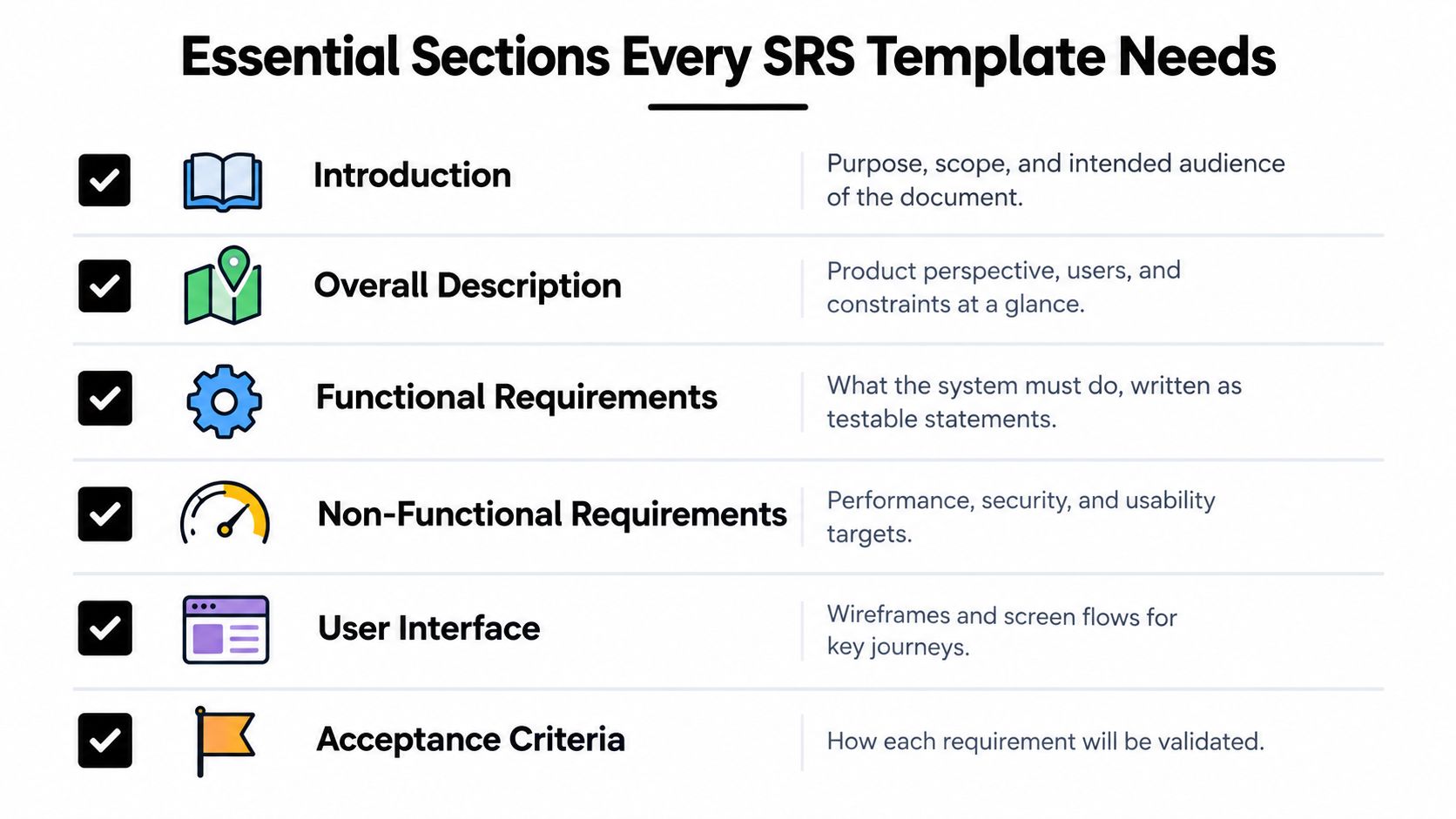
Use this adaptable structure rather than copying an oversized template without judgment.
Introduction
State the purpose, scope, audience, definitions, and references. Include what the product will not cover. A clear boundary prevents a later “while we're here” request from becoming part of the release.
Overall description
Describe the product perspective, primary users, operating context, assumptions, dependencies, and constraints. Explain how the system fits into the surrounding product or organization. If it depends on an identity provider, payment service, hardware device, or data source, name that dependency and describe the expected relationship.
Functional requirements
Write one behavior per requirement. Use a stable identifier and a direct statement such as:
The system shall allow an account owner to request a password reset by submitting a registered email address.
Then add the conditions that make it testable. What happens for an unknown address? What confirmation does the user receive? Which event is recorded? Avoid embedding implementation choices unless they are genuine constraints. The SRS should specify the required behavior, not prescribe a class name or database schema for no reason.
Non-functional requirements
Cover quality attributes such as performance, security, reliability, usability, maintainability, compatibility, and accessibility. A requirement like “the interface shall be fast” is a wish. A useful version defines the operation, conditions, measurement method, and acceptable result.
User interface and external interfaces
Document screen flows, user interaction rules, APIs, third-party integrations, hardware boundaries, communication interfaces, data formats, and error behavior. A beautiful mockup doesn't replace interface requirements. It shows appearance, while the SRS should clarify behavior and integration expectations.
Acceptance and verification
State how the team will validate each requirement. Link acceptance criteria to tests where possible, and record unresolved questions rather than hiding them in meeting notes. This guide to writing technical documentation is useful when you need the specification to remain understandable to both technical and non-technical readers.
A good template is a starting point, not a substitute for judgment. Keep detail where ambiguity creates risk, and keep low-risk implementation choices out of the requirements layer.
Managing Requirements Debt and Inevitable Gaps
A requirements specification is almost never complete at the first draft. One paper describes requirement specifications as “nearly never complete” and treats gaps as a systematic issue rather than a simple writing mistake. Its empirical survey also reports that experts viewed requirements gaps as a main reason for project failure. The paper on requirements gaps supports a more useful mindset: don't promise impossible completeness, build a process that exposes and controls uncertainty.
Requirements debt appears when flaws in identifying, formalizing, or implementing needs create distance between the intended specification and the delivered system. Ambiguous wording, contradictory rules, missing edge cases, and unrecorded assumptions all create opportunities for downstream rework. Recent expert literature on requirements debt connects these flaws to redesign, rework, and defects.
Track uncertainty instead of hiding it
Give every requirement an identifier, owner, source, priority, and state. Add explicit markers for questions, assumptions, dependencies, and decisions. An unresolved question isn't a failure. An unresolved question disguised as a finished requirement is.
A practical review can ask:
- Origin: Which business goal, user need, hazard, or constraint produced this requirement?
- Behavior: What must the system do, and under which conditions?
- Boundaries: What happens with invalid input, missing data, retries, permissions, and interruptions?
- Verification: What evidence will prove that the requirement is satisfied?
- Impact: Which interfaces, designs, tests, and operational processes change if this requirement changes?
For regulated or high-assurance systems, connect requirements to hazards and mitigations, not just tickets. That relationship lets teams assess impact deliberately instead of reconstructing rationale from old chat messages.
A gap you can see, assign, and review is manageable. A gap everyone assumes someone else handled is project debt.
Use a debt register alongside the SRS. Classify items by ambiguity, incompleteness, inconsistency, stale information, or missing trace links. Then schedule resolution as part of normal product work. You don't need to freeze the specification forever. You need to make change visible and keep the implementation aligned with the latest approved intent. These technical debt reduction practices apply especially well when requirements and code are drifting together.
Accelerating Your Workflow with AI Workspaces
A static Word document is a poor operating system for requirements. It stores prose, but it doesn't naturally remember why a sentence exists, compare related documents, identify contradictions, or maintain links between a business goal and a test case. The useful role for AI is not to invent product decisions. It is to reduce the mechanical effort of drafting, organizing, comparing, and reviewing decisions made by people.
A strong AI-assisted workflow begins with evidence. Feed the workspace stakeholder interview transcripts, existing product documentation, support themes, process diagrams, interface contracts, and known constraints. Ask the system to extract candidate needs and open questions, then have a human confirm the source before anything becomes an approved requirement.
Use AI for the first pass, not the final authority
A practical sequence looks like this:
- Extract: summarize interviews into actors, goals, pains, rules, and unresolved questions.
- Draft: generate candidate functional requirements, non-functional requirements, user flows, and acceptance criteria.
- Normalize: rewrite vague terms into observable language and flag undefined vocabulary.
- Cross-check: compare the SRS with the PRD, designs, API notes, and test plans.
- Trace: assign identifiers and propose links between needs, requirements, tasks, and tests.
- Review: ask human owners to approve, reject, or revise every material decision.
Multi-model access can be useful when different models are better suited to summarization, structured extraction, reasoning, coding, or rewriting. A Smart Notepad can help turn stakeholder language into clearer requirement prose, while document chat can surface every mention of a user role or business rule across large files. Deep research can support competitor and interface analysis, but external findings still need source review and product judgment.
Zemith brings multi-model AI access, document assistance, Smart Notepad, coding support, deep research, and organized Projects and Library workspaces into one environment. For an engineering team, the useful pattern is to keep the SRS, interview notes, design references, and review conversations in a shared project context rather than scattering them across browser tabs and disconnected subscriptions.
Automate checks that humans routinely miss
AI is particularly helpful for repetitive quality checks. Ask it to find requirements containing subjective terms, missing actors, multiple behaviors, undefined acronyms, absent error paths, or no acceptance criteria. Ask for a contradiction report that cites the exact requirement identifiers and source passages.
A 2025 IEEE article says recent AI advances can support broader analysis of IEEE 29148 quality attributes, including completeness and verifiability, and that generative AI may support automated requirements specification generation. The IEEE article on AI and requirements quality is a useful anchor, but the operating rule remains simple: AI proposes and checks, humans decide and approve.
Keep one source of truth, preserve version history, and never let generated text overwrite an approved requirement. Better team collaboration practices make the review process explicit, especially when product, engineering, design, and QA work asynchronously.
Common Pitfalls and Your Review Checklist
The most expensive SRS mistakes are usually ordinary words used without operational meaning. “The system should be user-friendly” expresses a hope, not a requirement. “The dashboard should load quickly” leaves the operation, conditions, measurement, and acceptable outcome undefined. “The API should support reporting” doesn't say who can call it, what data it returns, or how failures behave.
Another common mistake is mixing what the system must do with how the team will implement it. A requirement may need to mandate encryption, an external interface, or a regulatory constraint. It doesn't usually need to prescribe a particular variable name or internal class structure. Over-specifying implementation can make legitimate design improvements look like requirement violations.
Run the review as a quality gate
Don't ask reviewers whether they “like” the SRS. Ask them to challenge specific properties.
- Correctness: Does the requirement reflect an approved business or user need?
- Clarity: Could two reasonable readers interpret it differently?
- Atomicity: Does it contain one behavior, rather than several bundled together?
- Completeness: Are inputs, outputs, exceptions, permissions, and edge cases addressed?
- Consistency: Do terms, states, roles, and rules match other requirements?
- Feasibility: Can the team build and operate it within the known constraints?
- Verification: Can QA produce objective evidence of acceptance?
- Traceability: Is the source and downstream artifact recorded?
- Priority: Is its importance and stability clear?
- Currency: Does it still represent the product decision?
Have a developer, tester, and stakeholder review the same requirement from different angles. Their disagreements are valuable discovery. If everyone agrees instantly because the wording is pleasant and vague, the review probably hasn't gone deep enough.
Treating Your SRS as a Living Document
A signed SRS shouldn't become a museum exhibit. Product assumptions change, integrations evolve, regulations introduce constraints, and users expose edge cases that no workshop predicted. The document earns its keep only when it reflects the current approved behavior and helps the team evaluate change.
IEEE/ISO/IEC 29148 explicitly says requirements engineering is applied iteratively and recursively throughout the life cycle, and it replaced older standards including IEEE 830-1998, IEEE 1233-1998, and IEEE 1362-1998. The IEEE 29148 guidance supports the practical conclusion that an SRS is not a one-and-done deliverable.
Keep the SRS connected to the work:
- Update affected requirements when product decisions change.
- Record the decision, owner, rationale, and affected links.
- Re-run ambiguity and contradiction checks after major edits.
- Link implementation and tests back to requirement identifiers.
- Review stale assumptions during release planning and retrospectives.
The best software requirement specification document is not the longest one. It's the one the team trusts because it stays clear, current, testable, and connected to the product's actual intent.
Zemith gives teams one workspace for drafting, summarizing, researching, refining, and organizing the documents that support an AI-managed SRS. Visit Zemith to consolidate your requirements workflow and turn scattered project knowledge into a specification your team can build and test against.
Explore Zemith Features
Every top AI. One subscription.
ChatGPT, Claude, Gemini, DeepSeek, Grok & 25+ more


Always on, real-time AI.
Voice + screen share · instant answers
What's the best way to learn a new language?
Immersion and spaced repetition work best. Try consuming media in your target language daily.
Voice + screen share · AI answers in real time
Image Generation
Flux, Nano Banana, Ideogram, Recraft + more

Write at the speed of thought.
AI autocomplete, rewrite & expand on command
Any document. Any format.
PDF, URL, or YouTube → chat, quiz, podcast & more
Video Creation
Veo, Kling, Grok Imagine and more

Text to Speech
Natural AI voices, 30+ languages
Code Generation
Write, debug & explain code
Chat with Documents
Upload PDFs, analyze content
Your AI, in your pocket.
Full access on iOS & Android · synced everywhere
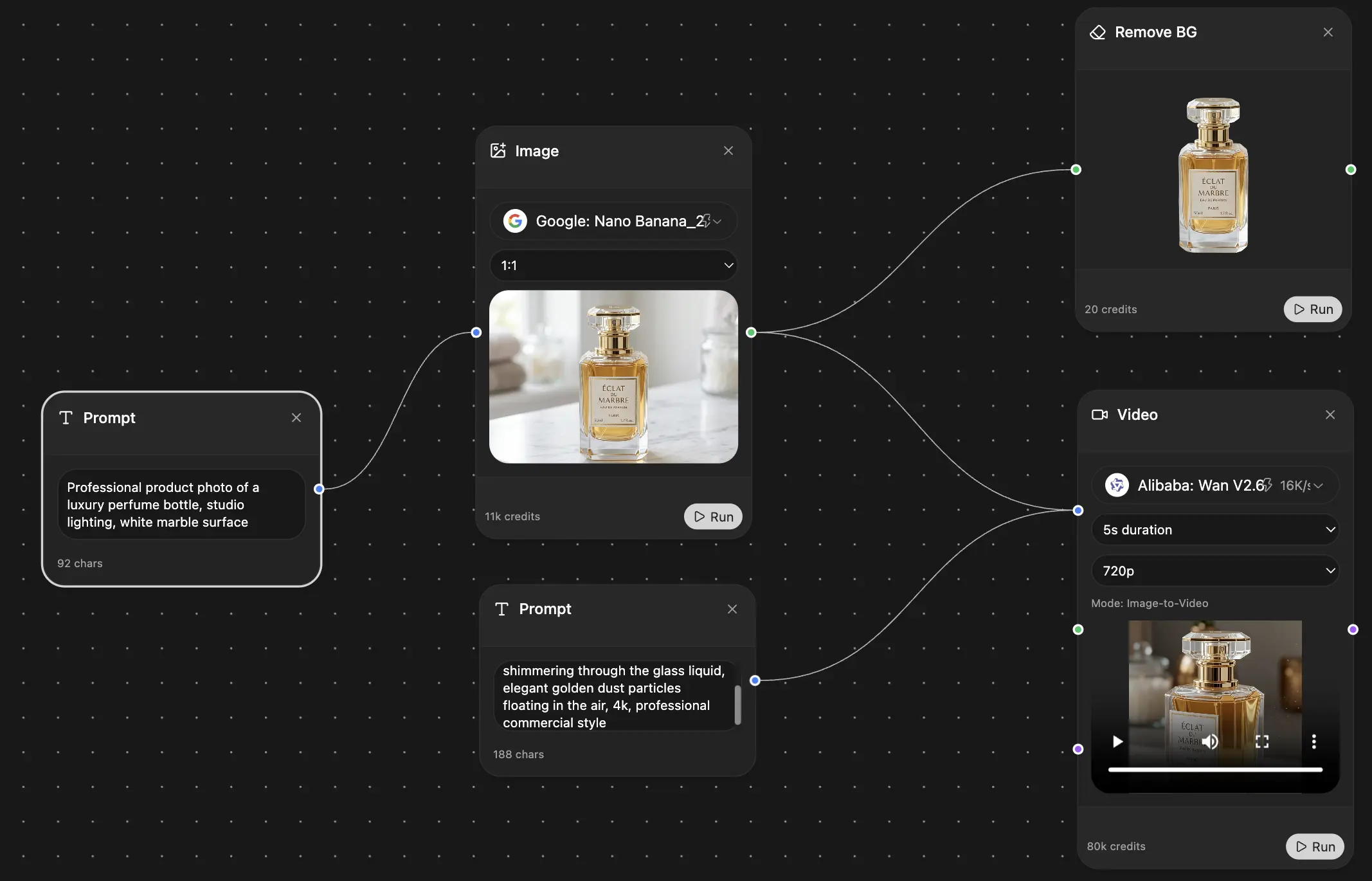
Your infinite AI canvas.
Chat, image, video & motion tools — side by side
Transparent, High-Value Pricing
Free
No credit card required
- Limited daily usage
- Selected AI models to try
- Limited features
Plus
- Choose from multiple leading models — GPT, Claude, Gemini and Grok.
- 25× more usage than Free.
- Create and edit images with Creative Studio.
- Connect your favorite apps and get work done in one place.
- Research the web and turn sources into clear answers.
- Turn documents, websites and YouTube into podcasts, flashcards and reports.
- Build repeatable workflows and stay focused with FocusOS.
Professional
- Everything in Plus, and:
- Unlock every model on Zemith, including GPT 6 Astra, Claude Opus and Sonar Pro.
- 50× more usage than Free.
- Create more with the full Creative Studio toolkit.
- Let agents work in the background — run Cloud tasks and schedule recurring work.
- Push further on complex work with Max Mode.
- First access to new features.
Trusted by teams at


What Our Users Say
Great Tool after 2 months usage
"I love the way multiple tools they integrated in one platform. Going in the right direction."
— simplyzubair
Best in Kind!
"The quality of data and sheer speed of responses is outstanding. I use this app every day."
— barefootmedicine
Simply awesome
"The credit system is fair, models are perfect, and the discord is very responsive. Quite awesome."
— MarianZ
Great for Document Analysis
"Just works. Simple to use and great for working with documents. Money well spent."
— yerch82
Great AI site with accessible LLMs
"The organization of features is better than all the other sites — even better than ChatGPT."
— sumore
Excellent Tool
"It lives up to the all-in-one claim. All the necessary functions with a well-designed, easy UI."
— AlphaLeaf
Well-rounded platform with solid LLMs
"The team clearly puts their heart and soul into this platform. Really solid extra functionality."
— SlothMachine
Best AI tool I've ever used
"Updates made almost daily, feedback is incredibly fast. Just look at the changelogs — consistency."
— reu0691