How to Write Ad Copy That Actually Converts (Without Being a Robot)
Tired of ads that don't perform? Learn how to write ad copy with our guide. We'll share proven frameworks, tips, and real examples to boost your conversions.
Let’s cut right to it. Writing ad copy that actually works boils down to one thing: solving a real human problem. It’s not about finding the cleverest tagline or using the biggest words. It’s about making a direct connection with someone and proving you’ve got the answer they’ve been looking for.
This simple idea is the bedrock of every single ad that gets clicks. Forget the MBA jargon; this is human-to-human stuff.
The Real Secret to Ad Copy That Clicks

Think about your own social media feed. It’s an endless stream of digital noise, right? We mindlessly scroll past hundreds of ads every single day. So what is it about that one ad that makes you stop, read, and maybe even click?
The secret isn’t some complicated formula. It's empathy. The best ads don't feel like ads at all; they feel like a conversation starter from a friend who gets it. They speak directly to your specific frustrations, your secret hopes, and your biggest goals.
It's no surprise the global copywriting market is set to explode, projected to hit USD 42.83 billion by 2030. With over 60% of ad dollars now spent on digital platforms, making a genuine connection is everything.
Building Your Customer Avatar (AKA Your New Best Friend)
Before a single word hits the page, you have to get crystal clear on who you're talking to. And I don’t mean vague demographics like "moms, 30-40." I mean really specific. You need to build a customer avatar—a detailed profile of your one ideal customer.
Give them a name. What’s their job title? What’s the one thing that keeps them staring at the ceiling at 2 AM? What do they dream of achieving? (And what’s their go-to coffee order? Okay, maybe not that last one, but you get the idea).
Pro Tip: Try this little mind trick: imagine you're writing a personal email to this one person. It instantly forces you to drop the stuffy corporate-speak and adopt a more direct, conversational tone. Write like a human, not a brochure from the 90s.
To flesh out your avatar, get to the heart of their emotional drivers:
- Pain Points: What’s their single biggest frustration that your product can solve? (Think: "I waste hours every week bouncing between different AI tools, and my workflow is an absolute dumpster fire.")
- Aspirations: What’s their ultimate dream outcome? (Maybe it's: "I just wish I had one single, streamlined place to manage all my creative work and research, so I can finally leave work on time.")
Once you truly understand these two things, the ad copy almost writes itself. You're not selling features anymore; you're offering a genuine solution to a painful problem. This is a foundational concept we cover in our guide on how to write engaging content.
Nailing the All-Important Hook
You’ve got about three seconds. That’s it. Three seconds to grab someone's attention before they scroll on by. Your "hook"—the very first line of your ad—is what makes or breaks your entire effort. A great hook taps directly into the pain point or aspiration you just mapped out.
For instance, forget a generic opener like "The Best AI Platform." Instead, try hitting a nerve: "Tired of juggling ten different AI subscriptions? So were we."
See the difference? That immediate, relatable connection is what separates the ads that get ignored from the ones that drive real, measurable results. For more inspiration, check out these to see how the pros do it.
Proven Copywriting Frameworks That Just Work
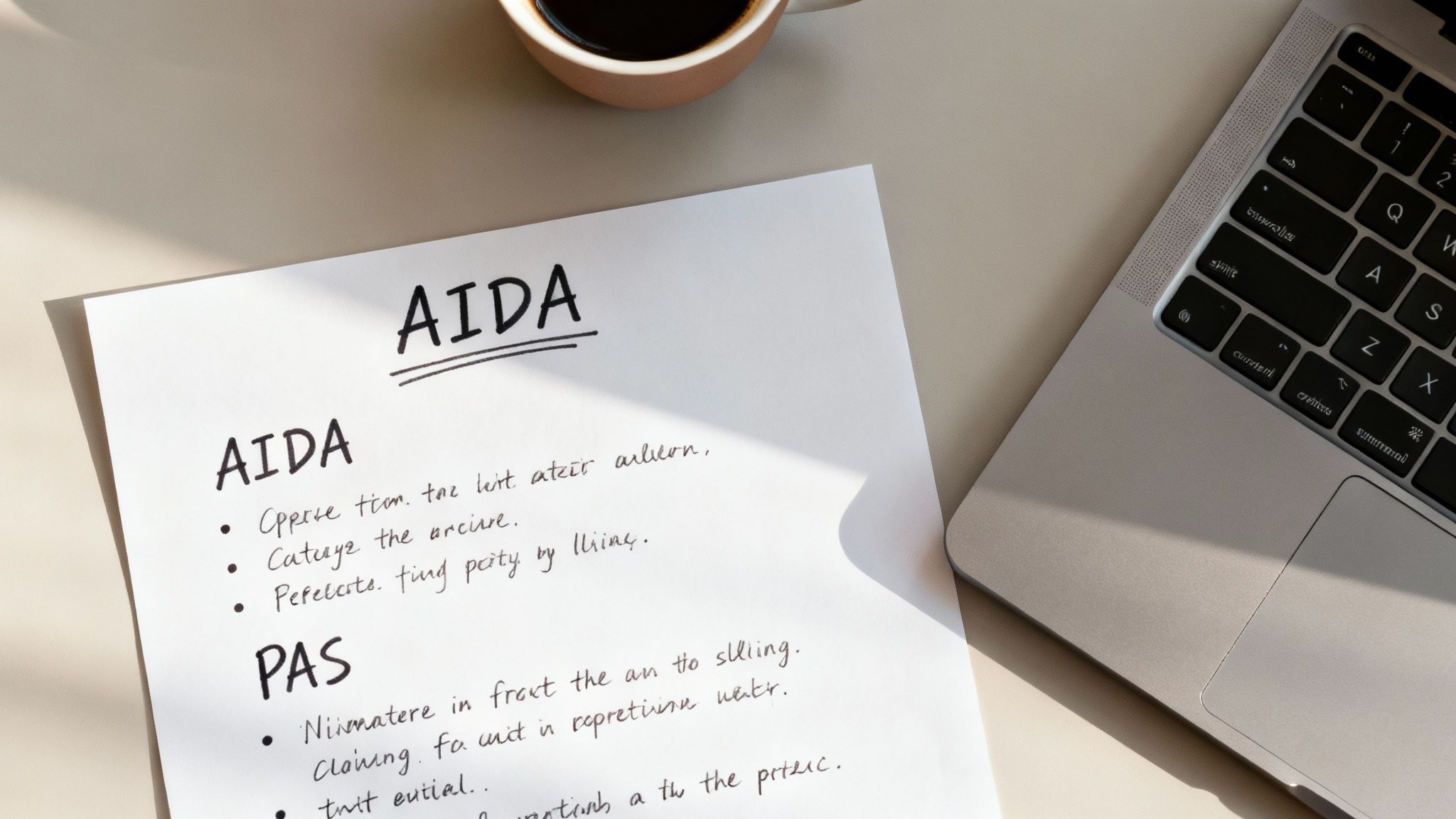
Alright, you’ve done the hard work of figuring out exactly who you're talking to. That’s huge. Now, let’s make sure the blank page never stares you down again.
The secret? Leaning on battle-tested frameworks. Don't think of these as strict rules that kill your creativity. Instead, see them as reliable recipes. They give you the structure, so you can focus on adding that unique flavor and flair that makes your ad pop. This is how the pros write ad copy that pulls in results, time and time again.
The AIDA Model: Attention, Interest, Desire, Action
This one's the OG of copywriting for a simple reason: it’s incredibly effective. AIDA is a straightforward, four-step model that takes a potential customer from "just scrolling" to "I need this now." It’s a classic because it perfectly maps to how people actually make decisions.
Here’s what it looks like in action for a ad:
- Attention: Kick things off with a hook that grabs them by the collar. A question that hits on a known frustration is perfect. “Is your AI workflow a chaotic mess of tabs and subscriptions?”
- Interest: Now, show them you get it. Empathize with their struggle and tease a better reality. “We’ve been there. Juggling 10 different tools just to get one project done is a creativity killer. That’s why we built one single workspace for everything.”
- Desire: This is where you make them want it. Paint a vivid picture of the awesome outcome they'll get. “Imagine brainstorming, writing, and creating stunning images—all in one place, with one login. That’s the power of Zemith.”
- Action: Leave no room for doubt. Tell them precisely what to do next. “Click here to start your free trial and simplify your workflow today!”
AIDA is my go-to for almost any ad campaign. It's versatile, easy to follow, and it forces you to build a logical path for your customer instead of just shouting features at them.
By following this flow, you’re not just selling; you’re telling a story that guides your audience right to the conversion.
The PAS Formula: Problem, Agitate, Solution
If AIDA is your friendly tour guide, PAS is more like a specialist who diagnoses a problem and provides the perfect cure. This framework is a powerhouse, especially when your audience is already feeling the pain and actively looking for a fix. It's like pouring a little salt in the wound before handing them the bandage.
It’s direct, punchy, and works wonders for platforms like where you have limited space to make an impact.
Check out how you could use PAS for a Google search ad:
- Problem: Get right to the point in your headline. “Disorganized AI Tools? Get Control.”
- Agitate: Give the problem a little twist to remind them why it’s so frustrating. “Stop Wasting Time & Money On Multiple Apps. End The Subscription Chaos.”
- Solution: Position your product as the clear, no-brainer answer. “Zemith Unifies Your Workflow. One App, All Models. Try It Free.”
This approach works so well because it instantly connects with what the user is already thinking. You validate their frustration and immediately offer the perfect remedy. When you need to be sharp, direct, and persuasive, PAS is an absolute killer.
Crafting Headlines and CTAs That Get Clicks
Let’s be brutally honest: if your headline stinks, the rest of your ad is toast. It’s the digital equivalent of a bouncer at a club—it decides who gets in and who keeps scrolling. Your headline carries 80% of the weight in getting someone to even consider reading the rest of your copy.
This isn’t just about being clever; it’s about making an instant connection. The goal is to make your ideal customer stop their thumb mid-scroll and think, "Wait, they're talking to me." The entire copywriting industry, valued at around $25.29 billion, is built on this very principle.
With social media click-through rates hovering at a modest 1.36%, every single word in that headline matters. .
The Anatomy of an Irresistible Headline
A killer headline isn't magic; it’s a calculated blend of psychology and clarity. You need to interrupt a pattern and promise immediate value.
Here are a few proven techniques you can steal:
- Use Specific Numbers: "How We Increased Our Leads by 127%" is infinitely more believable than "How to Get More Leads." Numbers just feel concrete and trustworthy.
- Ask an Intriguing Question: Frame a common pain point as a question. For example, "Are You Still Paying for Five Different AI Tools?" This makes the reader mentally say "yes" and lean in for the answer.
- Create Urgency (Without Being Cheesy): Instead of "Limited Time Offer," which everyone ignores, try something like, "Your Free Trial Ends This Week. Lock in Your Rate Now."
Crafting the perfect headline is an art, and for a deeper dive, you can check out our guide on that truly grab attention.
Your headline’s one and only job is to get the first sentence of your ad read. That’s it. Don’t try to sell your entire product in thirty characters.
Moving Beyond the Boring 'Learn More' Button
After you've hooked them with a great headline and body copy, you need to seal the deal with a compelling Call-to-Action (CTA). This is the final nudge, the last instruction that turns a passive reader into an active customer.
Let's agree to banish "Learn More" from our vocabulary forever. It’s lazy, uninspired, and frankly, a little disrespectful to the awesome copy you just wrote. A great CTA is benefit-driven and tells the user exactly what they're getting. It’s the difference between a weak suggestion and a confident command.
Instead of generic CTAs, try these action-oriented, value-packed alternatives:
Weak: Submit
Strong: Get Your Free AI Audit
Weak: Click Here
Strong: Start My 7-Day Free Trial
Weak: Download
Strong: Grab My Free Ebook Now
Think of your CTA as the final, critical step in your ad copy. Make it clear, compelling, and impossible to resist.
Using AI as Your Creative Co-Pilot
Let's talk about the elephant in the room: AI. It’s not here to steal your job or stamp out your creativity. Think of it as the ultimate creative co-pilot, ready to make you faster, smarter, and way more efficient.
When you partner with a powerful tool like , you get a secret weapon for writing ad copy that actually works. It's all about getting those brilliant ideas out of your head and onto the page without the usual friction and frustration.
You bring the strategy; AI brings the speed. It’s a pretty unbeatable combo.
Ending Writer’s Block for Good
We’ve all been there. Staring at that blinking cursor, waiting for an ounce of inspiration that just won’t show up. This is exactly where your AI co-pilot steps in, turning that dreaded blank page into a playground of possibilities. The goal here is to generate a ton of ideas, fast.
With something like Zemith’s Smart Notepad, you can brainstorm dozens of unique angles in seconds. Just feed it a simple prompt about your product and who you're talking to, then watch it spit out hooks, value propositions, and entire ad concepts.
Here’s what a quick brainstorming session can look like right inside the Zemith workspace.
The whole point is to keep the ideas flowing. The AI expands on your initial thoughts, so you never lose that creative momentum.
The goal isn't to find the one perfect ad on the first try. It's to generate 20 different ideas in two minutes, so you can cherry-pick the top 1% that truly resonates. AI makes that possible.
From Rough Ideas to Polished Drafts Instantly
Alright, so you've got a handful of solid concepts. The next step is turning them into properly structured ad copy. This used to be the part that took hours of agonizing over every single word.
Not anymore.
Zemith’s Document Assistant can take your messy brainstorms—even just a few bullet points—and instantly spin them into polished drafts. You can even tell it to use the AIDA or PAS frameworks we talked about earlier, and it will structure the copy perfectly.
- Your messy input: "New project management tool. Pain point: too many apps. Benefit: everything in one place. CTA: start free trial."
- The AI’s polished output: A fully-formed ad with a great headline, body copy that builds interest, benefits that create desire, and a clear call to action.
This process lets you jump from a raw idea to a test-ready ad in a tiny fraction of the time. If the first draft isn’t quite right, you can always use an to nail the perfect tone and style.
The Pro Tip for Platform-Specific Variations
Want a trick the pros use to get the most out of every campaign? They create platform-specific variations of a single core ad. Rewriting copy for every channel by hand is a massive time-sink. With AI, it’s practically effortless.
Once you've got a solid piece of ad copy, just ask your AI co-pilot in to adapt it.
- "Rewrite this for a witty Instagram post, and toss in some relevant emojis."
- "Now, turn it into a professional LinkedIn ad targeting marketing managers."
- "Shorten this down into a punchy Google Ads headline."
In less than a minute, you have multiple, perfectly tailored ads ready to go. This isn't about replacing your skill; it’s about amplifying it. You get to run a sophisticated multi-platform strategy without the burnout. Now that’s the real power of an AI co-pilot.
How to Write Ad Copy for Different Platforms
Trying to use the same ad copy on Google, Facebook, and TikTok is like showing up to a pool party in a full tuxedo. Sure, you look sharp, but you've completely misunderstood the assignment. Each platform is its own world, with a unique audience, a different vibe, and a totally separate set of expectations. If you treat them all the same, you’re just setting your ad budget on fire.
The real secret is getting inside the user’s head. Someone doom-scrolling on TikTok is in a completely different mental space than someone hunting for a specific solution on Google. Your ad copy needs to meet them right where they are, not where you wish they were.
Tailoring Your Tone and Message
Let's break it down. The kind of message that kills it on a professional, career-focused platform like LinkedIn will absolutely bomb on a visual-first, story-driven app like Instagram. Your offer might be identical, but the way you frame it has to change completely.
- Google Ads: This is all about search intent. Your copy needs to be a direct, clear answer to whatever the user typed into the search bar. Forget the fluff; it’s all about keywords, benefits, and precision.
- Facebook/Instagram: Think conversational and story-driven. People are on these platforms to connect with friends and be entertained. Your copy should feel less like a corporate broadcast and more like a post from someone they actually know.
- LinkedIn: Time to put on your professional authority hat. The audience here is all business. Use industry language they'll recognize, talk about ROI, and focus on how you can help them grow their career or company.
And when you're dialing in your copy for social platforms, don't forget the small details that make a big difference. For instance, learning to use can seriously amplify your ad's reach and pull the right people in.
Key Takeaway: Don't just tweak a few words; rethink your entire approach. The most important question to ask is: Is my user actively searching for an answer, or are they passively scrolling for a distraction? That single question changes everything.
Ad Copy Angles by Platform
To see this in action, let's say you're trying to advertise Zemith to a fellow marketing professional. You wouldn't just copy and paste the same ad everywhere. Instead, you'd adapt your angle to fit the platform's unique environment.
Here’s a quick look at how that might play out:
See the difference? It's subtle but powerful. Each version speaks directly to the user's immediate state of mind on that specific platform.
This kind of specific tuning is absolutely critical. After all, you're competing against 4.62 billion webpages and a never-ending stream of social media posts for attention. With 2.093 billion people on Facebook every day and 950 million members on LinkedIn, generic copy just gets lost in the noise. .
Getting these nuances right is the first step, but a cohesive plan is what truly drives results. For a deeper dive into building that out, check out our complete guide on .
Common Questions About Writing Ad Copy
Still have a few questions? You're not alone. Writing ad copy can feel like trying to hit a moving target in the dark. Let's clear up some of the most common things that trip people up.
How Long Should My Ad Copy Actually Be?
Ah, the million-dollar question. The honest answer? It depends. There’s no magic word count that works every single time. And anyone who tells you there is is probably trying to sell you something.
My rule of thumb is this: be as long as necessary to get your point across, but as short as humanly possible to keep their attention.
- Google Ads: You're working with tight constraints. Think of it like a headline contest where every character is precious. Focus on powerful keywords and the most direct benefit you can offer. No fluff.
- Facebook & Instagram Ads: Here, you've got more room to breathe. Sometimes a short, witty line is all you need. Other times, a longer, more personal story can build a real connection and drive amazing results. It's all about matching the format to the message.
The real key is to value clarity and impact above all else. Don't add words just to fill space.
What Are the Biggest Mistakes People Make When Writing Ad Copy?
It's painfully easy to fall into a few classic traps, especially when you're under pressure. By far, the biggest mistake I see is selling features instead of benefits.
No one really cares that your software has "proprietary AI integration." They care that it saves them 5 hours a week on tedious reports so they can leave work on time. Always frame your copy around the outcome for the customer.
I've seen these three mistakes kill otherwise great campaigns time and time again:
- Selling the "what" (features) instead of the "so what" (benefits).
- Using vague, insider jargon that your audience has to Google.
- Having a weak or confusing Call-to-Action that leaves people wondering what to do next.
Another huge one is trying to speak to everyone at once. When your ad is for "everybody," it ends up resonating with nobody. Zero in on your ideal customer and write directly to them, as if you're having a one-on-one conversation.
This is especially true when you consider the different platforms. Someone scrolling LinkedIn is in a totally different headspace than someone searching on Google.
Understanding that user mindset is half the battle. Your message has to fit the context, or it’s just noise.
How Do I Know if My Ad Copy Is Any Good?
Simple: let the data be your guide. The only way to really know if your copy is working is to test, test, and test again. A/B testing isn't just a marketing buzzword; it's your most reliable tool for figuring out what actually makes people click.
Start by testing big, meaningful changes first—like two completely different headlines or angles. Once you find a clear winner, you can start fine-tuning the smaller stuff, like your CTA button text or even a specific emoji.
If you're staring at a blank page struggling to come up with new test ideas, you might just be hitting a creative wall. We've all been there. For some practical tips on breaking through, check out our guide on .
When you look at your results, focus on two core metrics:
- Click-Through Rate (CTR): This tells you if your ad is grabbing attention and creating curiosity.
- Conversion Rate: This is the bottom line—it tells you if your ad is actually driving the action you want.
Explore Zemith Features
Every top AI. One subscription.
ChatGPT, Claude, Gemini, DeepSeek, Grok & 25+ more


Always on, real-time AI.
Voice + screen share · instant answers
What's the best way to learn a new language?
Immersion and spaced repetition work best. Try consuming media in your target language daily.
Voice + screen share · AI answers in real time
Image Generation
Flux, Nano Banana, Ideogram, Recraft + more

Write at the speed of thought.
AI autocomplete, rewrite & expand on command
Any document. Any format.
PDF, URL, or YouTube → chat, quiz, podcast & more
Video Creation
Veo, Kling, Grok Imagine and more

Text to Speech
Natural AI voices, 30+ languages
Code Generation
Write, debug & explain code
Chat with Documents
Upload PDFs, analyze content
Your AI, in your pocket.
Full access on iOS & Android · synced everywhere
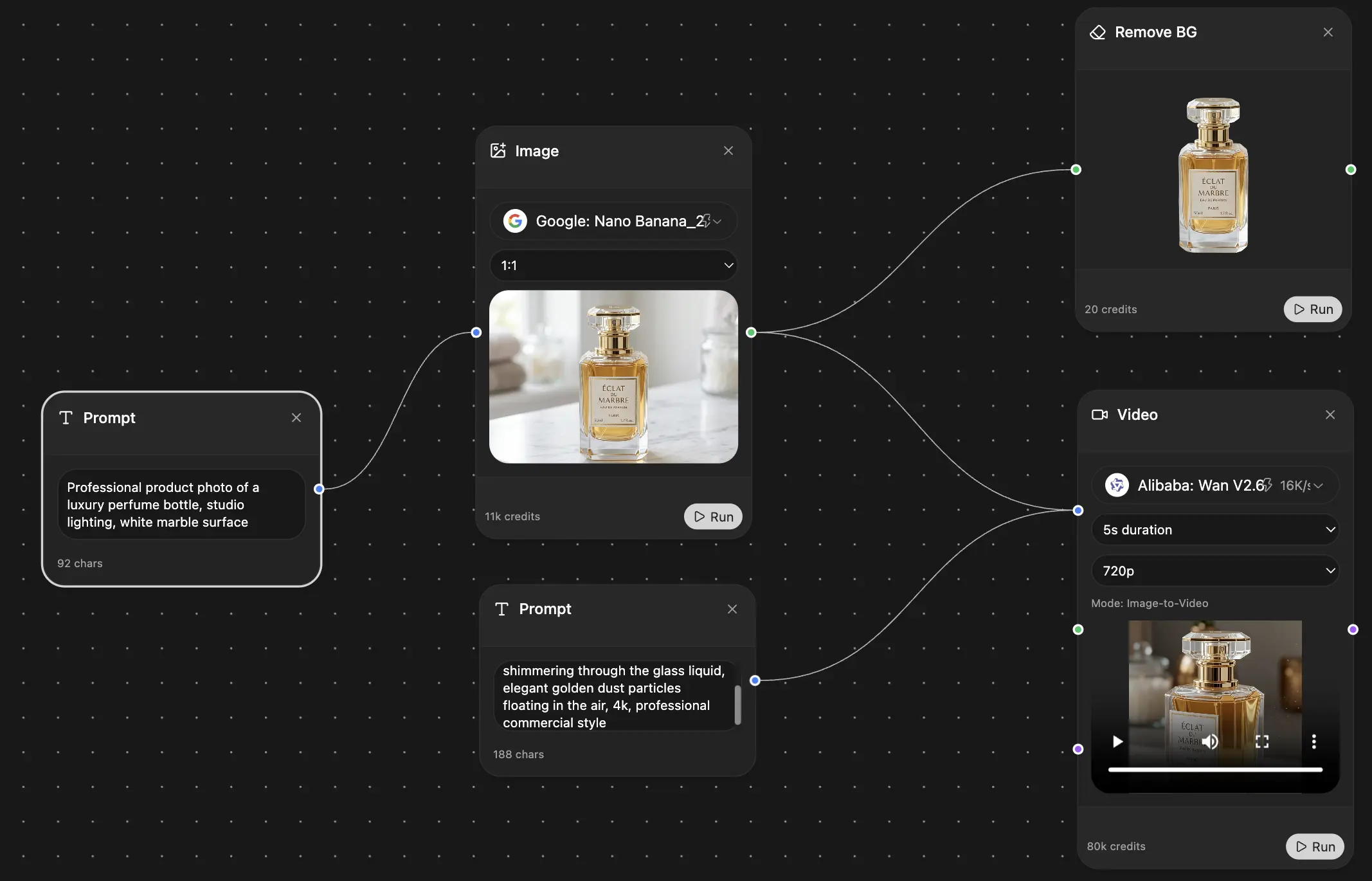
Your infinite AI canvas.
Chat, image, video & motion tools — side by side
Save hours of work and research
Transparent, High-Value Pricing
Trusted by teams at


Free
No credit card required
- 100 credits daily
- 3 AI models to try
- Basic AI chat
Plus
- 1,000,000 credits/month
- 25+ AI models — GPT, Claude, Gemini, Grok & more
- Agent Mode with web search, computer tools and more
- Creative Studio: image generation and video generation
- Project Library: chat with document, website and youtube, podcast generation, flashcards, reports and more
- Workflow Studio and FocusOS
Professional
- Everything in Plus, and:
- 2,100,000 credits/month
- Pro-exclusive models (Claude Opus, Grok 4, Sonar Pro)
- Motion Tools & Max Mode
- First access to latest features
- Access to additional offers
What Our Users Say
Great Tool after 2 months usage
"I love the way multiple tools they integrated in one platform. Going in the right direction."
— simplyzubair
Best in Kind!
"The quality of data and sheer speed of responses is outstanding. I use this app every day."
— barefootmedicine
Simply awesome
"The credit system is fair, models are perfect, and the discord is very responsive. Quite awesome."
— MarianZ
Great for Document Analysis
"Just works. Simple to use and great for working with documents. Money well spent."
— yerch82
Great AI site with accessible LLMs
"The organization of features is better than all the other sites — even better than ChatGPT."
— sumore
Excellent Tool
"It lives up to the all-in-one claim. All the necessary functions with a well-designed, easy UI."
— AlphaLeaf
Well-rounded platform with solid LLMs
"The team clearly puts their heart and soul into this platform. Really solid extra functionality."
— SlothMachine
Best AI tool I've ever used
"Updates made almost daily, feedback is incredibly fast. Just look at the changelogs — consistency."
— reu0691