How to Prepare for Coding Interviews: Your No-Sweat Guide
Discover how to prepare for coding interviews with a practical, step-by-step plan that covers study methods, mock problems, and proven tips to boost your score.
Alright, let's be honest. The words "coding interview" can send a shiver down the spine of even a seasoned software engineer. It often feels less like a job interview and more like a high-stakes, pop-quiz you forgot to study for. Did I just hear a "pop"? Nope, that was just my last remaining shred of confidence.
But here's the secret: preparing for it isn't black magic. It’s a process. It boils down to a manageable, repeatable plan: mastering core data structures, getting cozy with common algorithm patterns, and actually rehearsing how you'll answer behavioral questions. It’s all about having a solid game plan, not just hoping the interviewer asks you how to reverse a string.
Your Roadmap to Interview Success
So, you're ready to land that dream tech job. First of all, awesome. Making that decision is half the battle. Now for the part that feels like staring up at a mountain: the prep. This isn't just about grinding out hundreds of LeetCode problems until your eyes glaze over (we've all been there). It's about being strategic.
Think of this as your personal coaching plan, designed to get you from "Ugh, a binary tree" to "Heck yeah, I love a good graph problem." We're going to break down exactly how to prep for a coding interview for beginners and veterans alike with a clear, no-fluff strategy. Just actionable advice on what to study, how to practice, and how to structure your time.
The Game Plan
Here’s what we’ll cover:
- The Core Pillars: We'll dig into the absolute must-knows. This means Data Structures and Algorithms (obviously), but also the behavioral questions that trip up so many engineers and can be the difference between an offer and a "thanks, but no thanks" email.
- A Realistic Timeline: So, how long does this take? If you're starting from scratch or feeling rusty, a dedicated three to six months is a solid bet. You'll spend the first couple of months getting the fundamentals down before tackling the really tricky stuff. You can find more on realistic timelines in this .
- The Right Tools for the Job: The right tools can be a massive accelerator. We’ll look at how modern AI-driven platforms, like the integrated tools on , can be your secret weapon. Think personalized practice plans and instant feedback—it’s like having a 24/7 tutor who doesn't judge you for forgetting how a hash map works.
Here's the thing to remember: the goal isn't to memorize every algorithm ever invented. It's about learning to see the patterns, understanding the trade-offs of your choices, and being able to talk through your thought process. That's what interviewers actually care about.
This guide will give you that structured path, turning a giant, scary challenge into a series of small, manageable wins. Let's get into it.
To kick things off, let's summarize the key areas you'll need to focus on. Think of this table as your north star for the entire preparation journey.
Your Quick-Start Coding Interview Prep Checklist
Nailing these five areas is the surefire way to walk into your interviews feeling prepared and confident, not just hoping you get lucky with a question you've seen before.
Crafting Your Perfect Study Plan
Ever tried building IKEA furniture without the instructions? You might end up with something that sort of looks like a dresser, but it’s wobbly, you’re frustrated, and there's a pile of "extra" screws you hope weren't important. That's what preparing for a coding interview without a plan feels like.
A structured plan turns that overwhelming goal into a series of small, manageable wins. It really boils down to your timeline and where you're starting from. The process is pretty straightforward: study the concepts, practice applying them until it's second nature, and eventually, you achieve mastery.
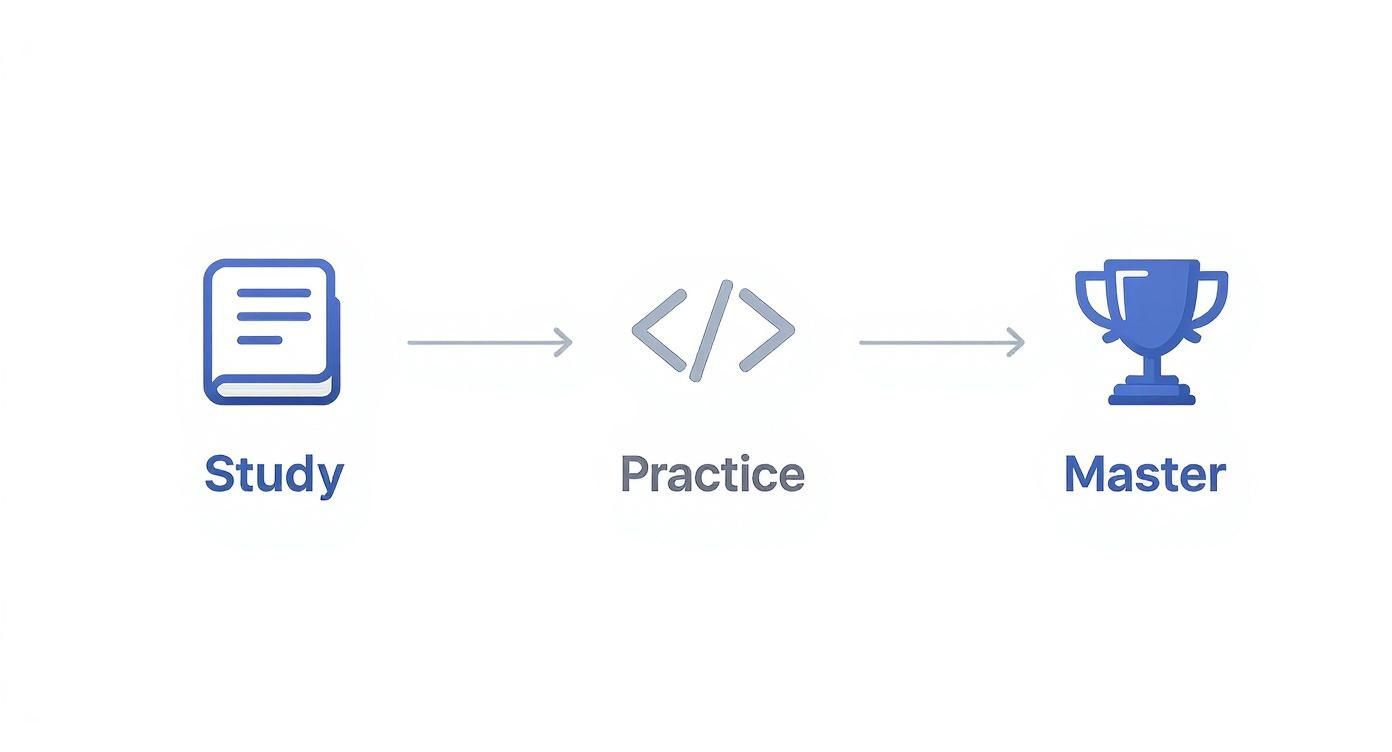
Each stage builds on the last, turning theory into the practical skill that interviewers are actually looking for.
Comparing 30 vs 60 vs 90-Day Prep Plans
Deciding on a timeline is your first big move. How soon are your interviews? What does your daily schedule look like for coding interview preparation? Here’s a quick breakdown to help you choose.
Ultimately, the best plan is the one you can actually stick to. Let’s dive into what each of these looks like in practice.
The 30-Day Full-Throttle Sprint
Got an interview breathing down your neck? This plan is your adrenaline shot. It's intense, demanding, and all about high-impact topics and rapid-fire pattern recognition.
- Weeks 1-2: Hammer the fundamentals. We're talking arrays, strings, hash maps, linked lists, and stacks/queues. Crush easy-to-medium problems to spot common patterns like two-pointers and sliding windows.
- Weeks 3-4: Shift gears to trees, graphs, and must-know algorithms like BFS and DFS. Start sprinkling in behavioral prep. Practice one STAR-method story every other day.
This is all about getting the maximum return on your time. Forget obscure algorithms; stick to what shows up in 80% of interviews.
The 60-Day Balanced Builder Approach
For most people, this timeline is the sweet spot. It gives you enough breathing room to actually learn the concepts properly without the frantic panic of a 30-day sprint.
- Weeks 1-4 (The Foundation): Go through the major data structures one by one. Spend a few days on each. Get the theory down before jumping into coding problems.
- Weeks 5-8 (The Grind): Now, ramp up the problem-solving. Focus on recognizing patterns across different topics. Start weaving in system design basics and block out time for mock interviews and behavioral prep.
This balanced strategy helps prevent burnout while making sure you’re ready for both the technical and the "tell me about a time when..." parts of the interview.
A key to staying organized is having a central place for your notes. Using a tool like Zemith's Smart Notepad helps you quickly jot down key concepts, save code snippets, and even use AI to rephrase complex explanations into simpler terms. It’s like a digital brain that never forgets the difference between a min-heap and a max-heap.
The 90-Day Deep Dive Marathon
This one's for those who want to build a truly rock-solid foundation. It's perfect if you're switching careers, new to DSA, or aiming for a top-tier company and want to leave no stone unturned.
- Month 1 (Bedrock): Go deep. Don't just solve problems for each data structure—try to explain it to a rubber duck. The goal here is total mastery of the basics.
- Month 2 (Expansion): Start pulling in more advanced topics like dynamic programming, heaps, and tries. Dedicate serious time to system design principles and start doing weekly mock interviews.
- Month 3 (Polish): The final month is all about refinement. Focus on harder problems, mock interviews where you concentrate on your communication style, and perfecting your behavioral stories.
No matter which plan you pick, consistency is king. Random, chaotic study sessions are way less effective than a steady, planned approach. For more tips, check out our guide on .
Mastering Data Structures and Algorithms
Alright, let's get into the main event. If coding interviews were a video game, Data Structures and Algorithms (DSA) would be the final boss. This is where most interviews are won or lost. The goal is to build pattern recognition so you can see a new problem and think, "Ah, this smells like a two-pointer problem," not, "Have I seen this exact problem before?"
The Must-Know DSA Greatest Hits
Think of these as your fundamental building blocks. If you get a solid handle on these, you’ll be ready for the vast majority of technical screens.
- Arrays and Strings: Your bread and butter. Get super comfortable with common patterns like the sliding window for subarray problems or the two-pointer technique for finding pairs.
- Hash Maps (or Dictionaries): Your secret weapon for optimization. If you're stuck on a brute-force solution that’s O(n²), ask yourself, "Can a hash map do this in O(n)?" The answer is very often yes.
- Linked Lists: Deceptively simple, but perfect for testing how well you handle pointers and edge cases. Practice reversing a list until you can do it in your sleep.
- Trees and Graphs: This is where things get more complex. You must know tree traversals (in-order, pre-order, post-order) and graph traversals (Breadth-First Search and Depth-First Search). These two algorithms are the foundation for a massive number of problems.
Mastering these topics is how you build a strong foundation for everything else that comes your way.
Big O Notation Without the Headache
Let's talk about Big O. It's really just a way to describe how your code's performance changes as the amount of input grows. Think of it like sending thank-you notes.
- O(1) - Constant Time: You mail one letter. The act of dropping it in the mailbox takes the same amount of time. This is the holy grail of efficiency.
- O(n) - Linear Time: You have to sign 100 letters. It's going to take you 100 times longer than signing just one. This is generally a good solution.
- O(n²) - Quadratic Time: You have to write a personalized note to every person in a room of 100, and in each note, reference every other person. The work grows exponentially. This is usually the "brute force" solution you'll want to optimize.
Your interviewer isn't just looking for a correct answer; they want to see that you can analyze these trade-offs and find an efficient one.
From Guesswork to Guided Practice
Just randomly picking problems off a list is like throwing darts in the dark. A much smarter approach is to use a targeted strategy that helps you zero in on your weak spots.
This is where AI-powered tools can be a game-changer. For example, Zemith’s problem recommender can analyze your performance and suggest the perfect problems to fill your knowledge gaps. No more wasting time on concepts you've already mastered.
This kind of personalized feedback loop turns your study sessions from random shots in the dark into precision-guided training. It's the most efficient way to prepare for technical coding interviews.
Recognizing Patterns is the Real Superpower
I'll let you in on a secret: acing the DSA interview isn't about solving 500 problems. It’s about solving 50 problems in a way that you deeply understand the underlying patterns.
The moment you stop trying to memorize solutions and start looking for the fundamental patterns is the moment you truly begin to master the coding interview. It's a shift from "what's the answer?" to "what kind of problem is this?"
Once you make this mental shift, you'll start seeing that most problems are just dressed-up versions of a few core ideas.
Common Patterns to Master
- Two Pointers: Incredibly useful for problems with sorted arrays or linked lists where you need to find a pair or a set of elements.
- Sliding Window: Perfect for array or string problems that ask for the optimal subarray or substring.
- BFS/DFS: Your go-to for any problem that can be modeled as a tree or a graph. Need the shortest path? Think BFS.
- Top K Elements: If you see the words "top," "least," or "most frequent," your brain should immediately scream "Heap!" A min-heap or max-heap is almost always the key.
Focusing on these patterns gives you a reusable toolkit. If you want to dive deeper, check out our guide on .
Nailing System Design and Behavioral Interviews
You just crushed the data structures problem. Flawless victory. But just as you’re about to celebrate, the interviewer says, “Okay, now let’s talk about system design.” For mid-level or senior engineers, this is where the real interview begins.
System design is about big-picture thinking, trade-offs, and handling ambiguity. The behavioral interview, on the other hand, is how they figure out if you're a human they'd actually want to work with. Spoiler alert: they do!
Demystifying the System Design Interview
The dreaded question: "Design Twitter." Your mind goes blank. It feels like being asked to build a skyscraper with a single Lego.
The trick isn't to have all the answers—it's to have a framework.
A Simple Framework for Any Design Question:
- Clarify the Requirements: Ask questions! How many users? Must-have features? Is it read-heavy or write-heavy? This shows you’re thoughtful, not just a code-slinging cowboy.
- Estimate the Scale: Do some quick, back-of-the-envelope math. How much data? How much traffic? This will inform your future design choices.
- Design the High-Level Components: Sketch it out on the whiteboard. Start with the basics: client, API gateway, application servers, databases, and maybe a cache.
- Dive Deep into a Specific Component: You can't design every detail in 45 minutes. Pick one interesting part—maybe the news feed generation or the database schema—and go deep.
Thinking about the data layer is especially important. Understanding some core can give you a massive advantage.
Don’t get lost in the weeds. The interviewer wants to see your thought process. It’s perfectly fine to say, "I'm not sure about this part, but here are two options and the pros and cons of each." That’s what a real engineer does.
Telling Your Story in the Behavioral Interview
After grilling you on tech, they’ll switch gears with questions like, "Tell me about a time you disagreed with your manager." Your new best friend is the STAR method.
- Situation: Briefly set the scene. (1-2 sentences)
- Task: What was your specific responsibility or goal? (1 sentence)
- Action: What did you specifically do? Use "I" statements, not "we."
- Result: What was the outcome? Quantify it if you can. Did you increase efficiency by 15%?
To get really good at this, start by looking at some and then practice telling your own stories out loud.
Rehearse and Refine with AI
Here's a pro tip: don't let the interview be the first time you say your stories out loud. Rehearsal is the solution, and AI can be an incredible practice partner.
Platforms like Zemith can really help here. You can use its Smart Notepad to write out your STAR stories. Then, ask its AI features for feedback: "Can you make this story more concise?" or "How can I better emphasize the result?" This turns a static script into a polished, interview-ready narrative.
It’s like having a career coach on demand, helping you perfect your delivery until you can tell your professional stories with confidence.
The Power of Mock Interviews and AI Feedback
Solving problems on your laptop, alone in your room, is one thing. Solving them while a real person watches you, asking probing questions as the clock ticks down? That's a completely different beast. It’s the difference between shooting hoops in your driveway and sinking a free throw in a packed stadium.
This is exactly why mock interviews are non-negotiable. They're the single best way to simulate the pressure and unpredictability of the real thing.
Getting the Most Out of Mock Interviews
Don't just go through the motions. To really get value out of these sessions, you have to be intentional about getting feedback.
- Switch Roles: Always take turns being the interviewer. It gives you a much better feel for what they’re looking for.
- Ask for Brutal Honesty: Tell your partner not to hold back. Was your communication clear? Did you explain your thought process well?
- Focus on Communication: The main goal isn't just getting the right answer. It’s practicing how to think out loud and make the interview feel like a collaborative problem-solving session.
The real magic of mock interviews happens when you get uncomfortable. That's where you find your blind spots—the rambling explanations, the panicked silence when you get stuck. These are the wrinkles you need to iron out.
Your 24/7 AI Interview Coach
Finding human partners is great, but scheduling can be a pain. What if you could get instant, expert-level feedback anytime you wanted? This is where AI tools completely change the game.
Top candidates often solve 50-80 problems and simulate interview conditions over and over again. This is where an AI-powered platform like Zemith becomes your unfair advantage. Instead of waiting for a partner, you can fire up the AI Mock Interviewer and get hundreds of reps in a safe, controlled environment.

This tool lets you talk through your solution out loud, and the AI gives you immediate feedback on your communication, technical accuracy, and overall problem-solving approach. The AI can even simulate different interviewer personalities—from the silent note-taker to the overly helpful one—preparing you for anything. This is a game-changer for anyone figuring out how to pass a technical interview.
It's also worth understanding the bigger picture of . By blending traditional mock interviews with AI-powered practice, you build the muscle memory for solving problems under pressure. To see how AI is changing development more broadly, check out our guide on the .
Your Coding Interview Questions Answered
You’ve ground through problems, you’ve followed a schedule, and you’re feeling mostly ready. But let’s be real—there are always a few last-minute questions that can mess with your confidence.
Think of this as your final pep talk. We’re going to tackle some of the most common “what if” scenarios to help you walk into that interview room feeling solid.
What’s the Best Programming Language to Use?
This question causes way more anxiety than it deserves. The short answer? The one you know best.
Seriously. Your goal is to show off how you think. Interviewers would much rather see you solve a problem fluently in Python, Java, or C++ than watch you stumble through unfamiliar syntax. Comfort leads to speed and clarity.
That said, there are a few practical things to keep in mind:
- Python: A fan favorite for a reason. Its clean syntax is almost like writing pseudocode, which is fantastic for getting ideas across quickly.
- Java/C++: Excellent, reliable choices, especially if you're interviewing with bigger, more established tech companies.
My advice? Avoid super-niche languages unless the job description specifically calls for it. You don’t want to waste ten precious minutes trying to implement a basic hash map from scratch.
What If I Completely Blank on a Problem?
First off, take a breath. It happens to literally everyone. How you recover from being stuck is often a more important signal than getting the answer right away.
The absolute worst thing you can do is sit there in panicked silence. Your thought process is the product you’re selling, not just the final lines of code.
Here's your game plan for when your mind goes blank:
- Talk It Out: Start by just repeating the problem back in your own words. "Okay, so if I'm understanding this right, we need to find the shortest path..." This buys you time and confirms you’re on the right track.
- Start with Brute Force: What's the most obvious, clunky solution? Say it! "Well, the brute-force approach would be to check every single combination..." This proves you can solve the problem and gives you a baseline to optimize from.
- Think About the Data: Look at the inputs. Is it a sorted array? Two-pointer techniques should come to mind. Does the problem mention "top K"? That’s a huge hint for heaps. Honing this skill is a lot like learning effectively.
Is It Okay to Postpone an Interview?
Yes. A thousand times, yes. This is a little-known secret that can literally save your candidacy. A recruiter would much rather you interview successfully in two months than fail tomorrow.
If a recruiter reaches out and you know you aren’t ready, it is 100% okay to say so.
Here's a simple script you can adapt:
"Thanks so much for reaching out! I’m really excited about this opportunity at [Company Name]. To be honest, I want to make sure I put my best foot forward, and I'd like a bit more time to prepare. Would it be possible to schedule my interview for around [suggest a date a few weeks out]?"
This shows self-awareness and respect for their time. It’s far better to delay and get the offer than to rush in, bomb the interview, and face a one-year cooldown period before you can apply again.
Ready to turn all this knowledge into action? Zemith is your all-in-one AI partner for interview prep. From using the AI Mock Interviewer to get live feedback, to organizing your notes in the Smart Notepad, we give you the tools to practice smarter, not just harder. Stop juggling dozens of sites and start preparing with a single, powerful platform. and walk into your next interview with the confidence you deserve.
Explorer les fonctionnalités de Zemith
Toute l'IA top. Un abonnement.
ChatGPT, Claude, Gemini, DeepSeek, Grok et 25+ modèles


Toujours active, IA en temps réel.
Voix + partage d'écran · réponses instantanées
Quelle est la meilleure façon d'apprendre une nouvelle langue ?
L'immersion et la répétition espacée fonctionnent le mieux. Essayez de consommer des médias dans votre langue cible quotidiennement.
Voix + partage d'écran · L'IA répond en temps réel
Génération d'images
Flux, Nano Banana, Ideogram, Recraft + plus

Écrivez à la vitesse de la pensée.
Auto-complétion IA, réécriture et expansion sur commande
Tout document. Tout format.
PDF, URL ou YouTube → chat, quiz, podcast et plus
Création vidéo
Veo, Kling, MiniMax, Sora + plus

Synthèse vocale
Voix IA naturelles, 30+ langues
Génération de code
Écrire, déboguer et expliquer du code
Chat avec documents
Téléchargez des PDF, analysez le contenu
Votre IA dans votre poche.
Accès complet sur iOS et Android · synchronisé partout
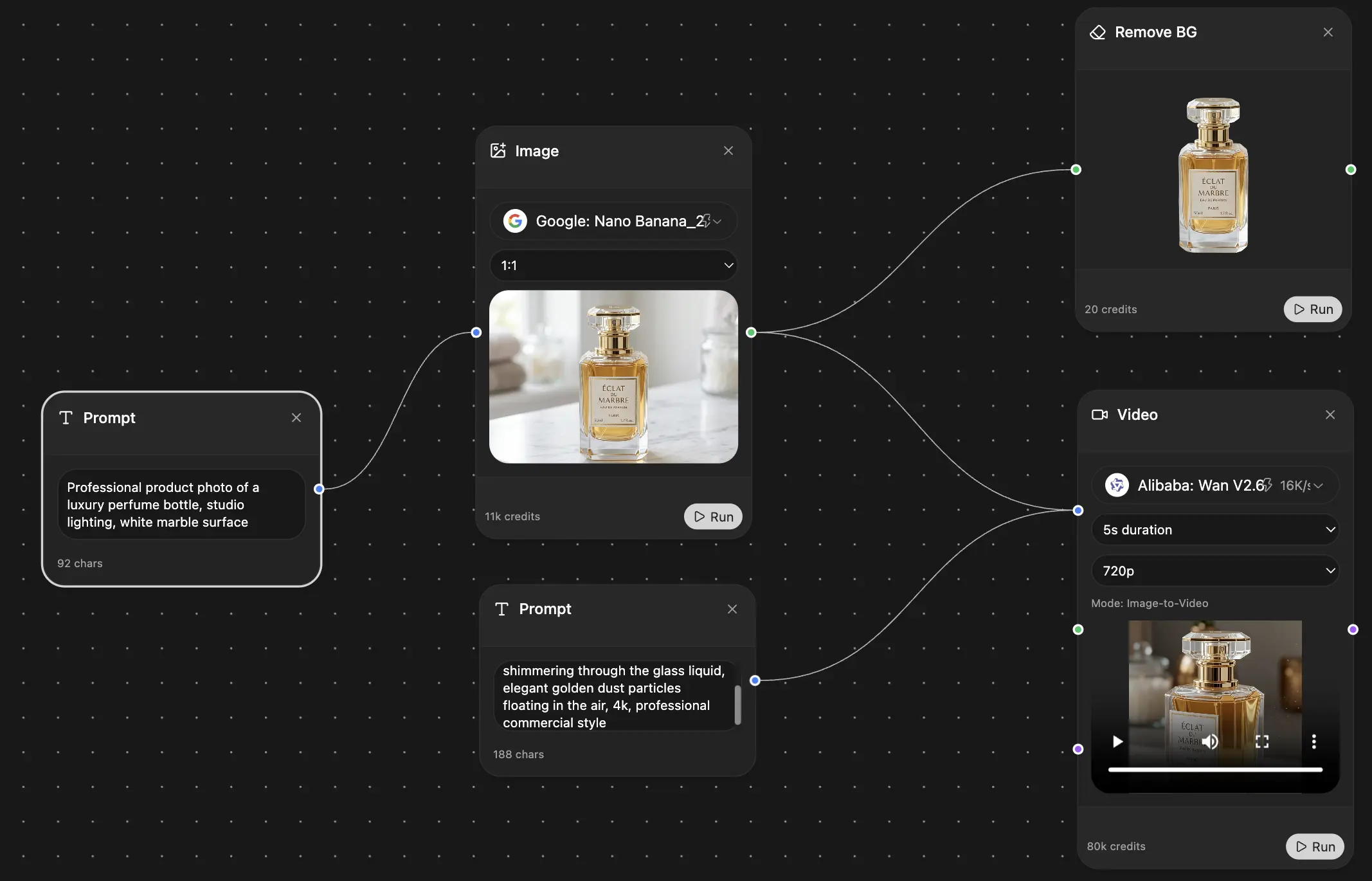
Votre canevas IA infini.
Chat, image, vidéo et outils de mouvement — côte à côte
Économisez des heures de travail et de recherche
Tarification simple et abordable
Adopté par des équipes chez


Gratuit
Aucune carte de crédit requise
- 100 crédits par jour
- 3 modèles d'IA à essayer
- Chat IA basique
Plus
- 1 000 000 crédits/mois
- 25+ modèles d'IA — GPT, Claude, Gemini, Grok et plus
- Agent Mode avec recherche web, outils informatiques et plus
- Creative Studio : génération d'images et de vidéos
- Project Library : discutez avec des documents, sites web et YouTube, génération de podcasts, fiches de révision, rapports et plus
- Workflow Studio et FocusOS
Professionnel
- Tout ce qui est dans Plus, plus :
- 2 100 000 crédits/mois
- Modèles exclusifs Pro (Claude Opus, Grok 4, Sonar Pro)
- Motion Tools et Max Mode
- Premier accès aux dernières fonctionnalités
- Accès aux offres supplémentaires
Ce que disent nos utilisateurs
Great Tool after 2 months usage
"I love the way multiple tools they integrated in one platform. Going in the right direction."
— simplyzubair
Best in Kind!
"The quality of data and sheer speed of responses is outstanding. I use this app every day."
— barefootmedicine
Simply awesome
"The credit system is fair, models are perfect, and the discord is very responsive. Quite awesome."
— MarianZ
Great for Document Analysis
"Just works. Simple to use and great for working with documents. Money well spent."
— yerch82
Great AI site with accessible LLMs
"The organization of features is better than all the other sites — even better than ChatGPT."
— sumore
Excellent Tool
"It lives up to the all-in-one claim. All the necessary functions with a well-designed, easy UI."
— AlphaLeaf
Well-rounded platform with solid LLMs
"The team clearly puts their heart and soul into this platform. Really solid extra functionality."
— SlothMachine
Best AI tool I've ever used
"Updates made almost daily, feedback is incredibly fast. Just look at the changelogs — consistency."
— reu0691