How to Analyze Primary Sources Like a Pro (Without Falling Asleep)
Learn how to analyze primary sources with our guide. Get practical tips to decode historical documents, photos, and letters like a seasoned historian.
Analyzing a primary source is really about one thing: asking smart questions. You're essentially putting on a detective hat to investigate a firsthand account and figure out what it really means. This means digging into where it came from, understanding the world it was created in, and trying to get inside the head of the person who made it to see their purpose and potential biases.
It's about looking past the surface—what the source says—to uncover what it reveals.
Your 6-Step Methodology for Analyzing Primary Sources
Ever feel like a time-traveling detective? That’s what it’s like to analyze a primary source. It's your backstage pass to history, a chance to hear it straight from the horse's mouth instead of a dry textbook. Forget just memorizing dates; this is about getting your hands dirty with the raw, messy, and fascinating stuff of the past.
Think of this guide as your practical playbook. No academic jargon, just straightforward, actionable advice for decoding everything from a Civil War soldier’s letter to a grainy photograph from the 1920s. We'll walk through how to ask the right questions, spot the subtle clues, and piece together the evidence to build a compelling story. Ready to look at the past with fresh, confident eyes? Let's do this.
Step 1: Lay the Groundwork with Foundational Questions
Before you dive headfirst into a document, you need a basic game plan. This isn't about following a rigid checklist but about orienting your thinking so you don’t miss the big picture. It’s like checking your compass before heading into the woods. Or, you know, checking Google Maps.
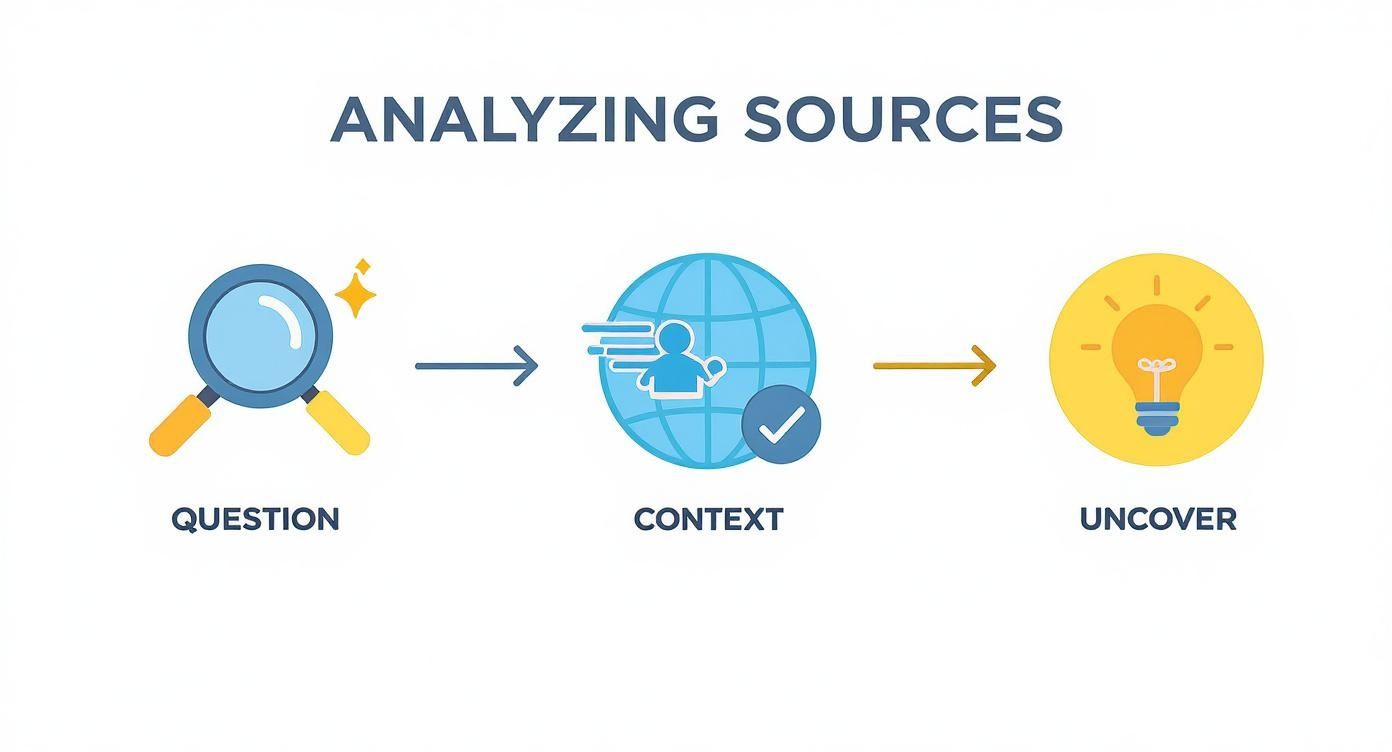
This cycle of questioning, contextualizing, and uncovering is what helps you build a strong, evidence-based interpretation of any source you encounter.
Before you dive deep, use this table as a quick mental checklist. Asking these fundamental questions will frame your entire analysis.
The Core Questions for Source Analysis
Thinking through these questions from the get-go gives you a solid foundation to build upon as you move into a more detailed analysis.
Step 2: Grasp the Historical Context
A primary source never exists in a vacuum. It’s a product of its time, place, and culture, and if you ignore that, you're missing half the story. To really get it, you need to zoom out and understand the world in which it was created.
Ask yourself:
- What major events were happening at the time? Think wars, economic depressions, social movements, or scientific breakthroughs.
- What were the prevailing social norms, beliefs, and values? What was considered "normal" or controversial back then?
- Who held the power? Understanding the political and social structures of the era is crucial.
For example, analyzing a pamphlet from the women's suffrage movement in the early 1900s is meaningless without knowing that, at the time, women couldn't vote, had limited property rights, and were largely excluded from public life. That context is what gives the document its power and urgency.
Step 3: Perform a Close Reading
Now it’s time to zoom in—way in. Close reading is the art of paying meticulous attention to the details of the source itself. This is where you move from a general overview to a forensic examination of the evidence.
For Texts: Pay attention to specific word choices (diction), the emotional feel of the language (tone), and the underlying argument or structure (rhetoric). Why this word and not another? Is the tone angry, celebratory, or sarcastic? A great example is the U.S. Declaration of Independence—every single word was chosen with incredible care to build a legal and moral case for revolution.
For Images: Look at the composition. What’s in the foreground versus the background? Who or what is the focal point? Consider the use of light, shadow, and color. In a photograph, think about what is included in the frame and, just as importantly, what might have been left out.
For Objects: Examine the materials used, the craftsmanship, and any signs of wear and tear. A hand-stitched quilt tells a different story about labor and domestic life than a factory-made one.
This is where the real "aha!" moments happen. A single word or a tiny detail can unlock the entire meaning of a source.
Putting Your Source into Context
Trying to analyze a primary source without its context is like walking into the middle of a movie. You see what's happening on screen, but you have no idea who the characters are, what led to this moment, or why any of it matters. A document, a photograph, or an artifact is just a floating piece of data until you anchor it to its time and place.
This is where the real detective work begins.
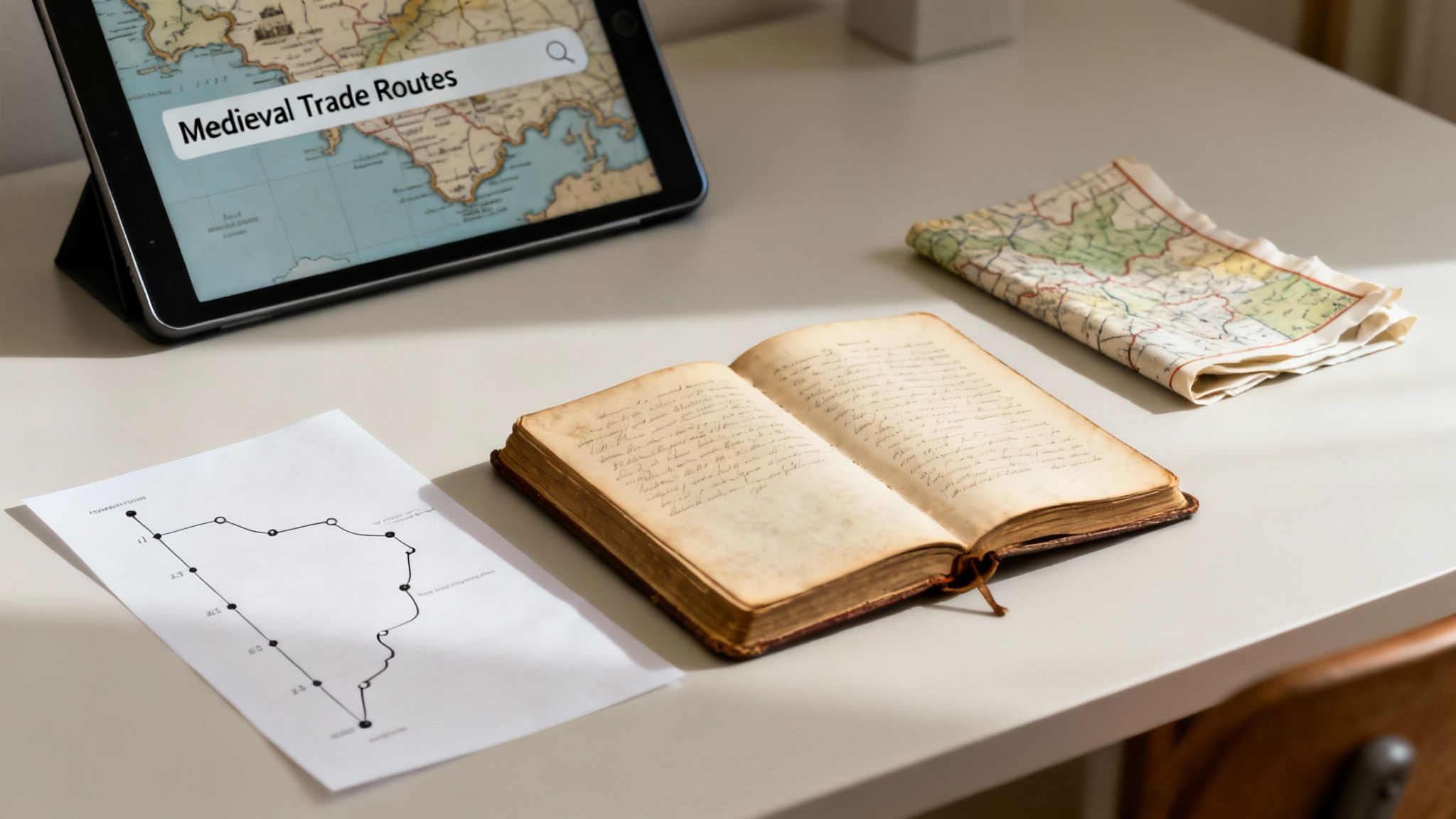
It’s about more than just knowing a date. You need to get a feel for the era—what was going on, what people were thinking, and what the general "vibe" was. A diary entry from a teenager in 1968 is going to read completely differently than one from 1988, all because of the massive shifts in culture, politics, and technology. Context is everything.
Building Your Historical Backdrop
First things first, you need to paint a broad picture of the historical landscape. You don't need a PhD in the subject (not yet, anyway!), but you do need a solid grasp of the major forces at play when your source came into being.
Think of it this way: if your source is an actor on a stage, the context is the set, the lighting, and the script everyone else is following. Without that backdrop, the actor's lines just don't make sense.
I always start by asking a few big-picture questions:
- What major events were unfolding? Was there a war, a revolution, a major election, an economic crash?
- What was daily life like? Think about the available technology, common jobs, and social norms. A letter complaining about a four-day journey by horse hits differently when you remember that was the only option.
- What big ideas were in the air? What were people arguing about? Were there major debates about religion, science, or politics? What were the dominant cultural values or anxieties?
To really understand a source, you have to appreciate its place in the grand scheme of things. This means thinking about and why some documents leave a lasting echo while others fade. It's the key to figuring out why your source matters.
Practical Tools for Gathering Context
So, how do you actually find all this information without getting lost in a library for a decade? Luckily, you've got some powerful shortcuts. This is where your research skills come into play, and it’s a huge part of learning how to analyze primary sources like a pro.
Pro-Tip: Don't get bogged down in the details. The goal is to gather enough context to make sense of your source, not to become the world's leading expert on 18th-century teacups (unless that's your thing, of course).
Here are a few of my go-to starting points for a contextual deep dive:
- Digital Encyclopedias and Timelines: Sites like Encyclopedia Britannica or even a well-sourced Wikipedia page are great for a quick overview. Timelines are fantastic for seeing how different events line up chronologically.
- Secondary Sources: This is a big one. Look for scholarly articles or books written by historians who have already studied the period. They've done a lot of the heavy lifting for you!
- AI-Powered Research Assistants: Here’s where you can really speed things up. Think of an AI tool as your personal research sidekick.
For instance, you can use an AI assistant like Zemith to quickly pull the background info you need. Instead of spending hours searching, you can just ask it to "summarize the main political conflicts in France during the 1840s" or "list common household technologies in America in 1955."
This frees you up to spend more time on the actual analysis. Building this foundational knowledge is central to honing your analytical skills, and our guide on can help sharpen that muscle. By letting tech handle some of the grunt work, you can focus on the fun part: solving the historical puzzle.
How to Do a Close Reading of Your Source
Okay, you’ve got your source situated in its time and place. Now, it’s time to get out the magnifying glass. This is where we shift from a broad overview to a close reading, dissecting the source word-by-word, brushstroke-by-brushstroke. We’re digging deeper than just what the source says on the surface—we want to understand how it’s saying it.
Think of yourself as a detective dusting for fingerprints. Anyone can see the document, but you’re looking for the subtle word choices, the specific imagery, and the unspoken assumptions that really tell the story. It's the difference between just reading a sign and figuring out who painted it, why they picked that specific font, and what they were trying to make you feel.
Unpacking Written Documents
When you're dealing with text—a letter, a diary, a government report—every single word is a potential clue. You're essentially looking for the author's fingerprints all over the language.
Start by getting a feel for the author's tone. Is the language formal and detached, or is it dripping with passion and personal feeling? A government report on poverty will read very differently from a fundraising letter by a charity, even if they’re both describing the exact same conditions.
Next, hunt for the agenda. What is the author trying to do here? Are they trying to inform, persuade, entertain, or maybe justify their own actions? Keep an eye out for loaded words or phrases that pack an emotional punch. Words like "heroic," "treacherous," "freedom," or "tyranny" are rarely neutral; they're chosen to steer your opinion.
Let’s use a real-world example: an old advertisement for a "miracle" health tonic from the early 20th century.
- Word Choice: Does it use scientific-sounding jargon to seem legitimate, like "scientifically formulated with hydro-botanicals"?
- Persuasive Language: Does it promise to "cure" a laundry list of unrelated ailments, preying on people's hopes and fears?
- Intended Audience: Is the language simple and direct, aimed at a general audience? Or is it more complex to appeal to educated readers?
Breaking it down like this shows the ad isn't just selling a bottle of stuff; it's selling an idea about health, modernity, and trust in "science." This kind of detailed analysis is a cornerstone of good research.
Decoding Visual Sources
Photographs, paintings, and political cartoons don't have words, but they absolutely have their own grammar. When you're analyzing a visual source, you need to think like an art director.
Start with the composition. What did the creator place right in the center of the frame? Who or what is pushed to the margins or cast in shadow? The most prominent element is almost always what the creator considered most important.
Then, consider the perspective. Is the photo taken from above, making the subject look small and vulnerable? Or is it shot from below, making them seem powerful and imposing? This single choice can completely change the message.
Finally, look for symbolism. In a political cartoon, an olive branch is a shortcut for peace, a storm cloud means trouble, and a grasping octopus often represents a greedy, sprawling empire or corporation. These are visual cues meant to convey complex ideas in an instant.
As you get into the weeds with your close reading, you need to be able to capture what you find without injecting your own bias. A great can help you faithfully represent the source's core message.
Whether you're looking at text or an image, this meticulous approach forces you to slow down and see what you’d otherwise miss. By doing a close read, you stop being a passive consumer of information and become a true analyst, capable of uncovering the layers of meaning hidden just beneath the surface.
Connecting the Dots with More Sources
Think of your first primary source as one person’s story at a crowded party. It might be compelling and full of detail, but it’s still just one perspective. To really understand what happened, you need to walk around and talk to a few other people. That’s the essence of corroboration—comparing multiple sources to piece together a more reliable and complete picture of the past.
A single document is rarely the whole story. When you place different sources in conversation with one another, you start to spot patterns, notice contradictions, and uncover the subtle details that make history come alive. This is an absolutely essential skill when you're figuring out how to analyze primary sources for a research paper.
Playing Historical Detective with Sourcing
Before you even think about comparing documents, you have to investigate each source on its own. This process, called sourcing, is all about putting on your detective hat to figure out the who, what, when, where, and why of its creation. It’s the background check that tells you how much you can really trust what you’re reading.
Get in the habit of asking these critical sourcing questions:
- Who made this? Was the creator an eyewitness with firsthand knowledge, or were they repeating gossip they overheard? A soldier’s diary from the front lines offers a completely different kind of evidence than a newspaper report written a thousand miles away.
- Why did they create it? Was this document meant to persuade, inform, record a private memory, or fulfill a bureaucratic requirement? The motive behind a source will always shape its content and potential biases.
- Who was this for? A private letter between two friends is going to have a very different tone and level of honesty than a public speech designed to rally a crowd.
This upfront work is non-negotiable. Judging a source's reliability from the get-go saves you from building an entire argument on a shaky foundation. It's the difference between a solid historical interpretation and a house of cards ready to tumble.
Building Your Case with Multiple Sources
After you've properly vetted your initial source, it's time to bring in others. Your goal is to see if other evidence backs up its claims or, just as importantly, challenges them. This is often where the most exciting historical discoveries happen—especially when sources disagree.
Let's say you find a letter from a factory owner in the 1890s who claims his workers are happy and well-treated. That’s one piece of the puzzle. To corroborate his story, you might hunt down:
- Other Primary Sources: What do the factory's own payroll records show? Did local newspapers from that time report any strikes or labor disputes? Do any surviving diary entries from the workers tell a different story?
- Secondary Sources: What have professional historians already written about labor conditions in that specific industry and city during that decade? Their broader research can provide invaluable context.
Analyzing primary sources is a core skill for any researcher, and systematically evaluating where a document comes from is key. For instance, the American Historical Association found that over 75% of historians rely on government documents as primary sources, with census records being a goldmine for social history. By cross-referencing multiple censuses, a historian can track massive trends, like how the U.S. population shifted from 6% urban in 1790 to over 80% by 2020. You can learn more about .
A Key Takeaway: When sources conflict, don't just pick the one that fits your argument best. The disagreement itself is a huge clue. It points you toward different perspectives, hidden agendas, or a more complicated truth than any single source could ever reveal.
This whole process of gathering, comparing, and piecing together information from various sources can get messy fast. Keeping your findings organized is crucial for seeing the bigger picture. To keep your evidence straight as you connect the dots, check out our guide on for some practical tips.
Using Digital Archives and AI in Your Research
Welcome to the future of historical research. Let's be honest, learning how to analyze primary sources used to mean spending weeks in a dusty library basement. While there's a certain romance to that (and a specific smell), today, the internet puts a world of historical treasure right at your fingertips.
This shift has been a massive game-changer. Digital archives have completely transformed our access to historical documents. Major platforms now host millions of digitized manuscripts, newspapers, and government records, and the scale is mind-boggling. Some collections, for example, contain over 100,000 pages of official records tracking major epidemics, giving researchers a view that was once impossible. These digital archives often come with powerful search tools, letting you filter by date, location, and topic to find exactly what you need. A great starting point is exploring some of the top-tier .
Tapping into Digital Treasure Troves
Think of digital archives as your personal, 24/7 research library. Massive databases like and are gateways to a staggering amount of material. You can uncover everything from Colonial-era newspapers to recently declassified government memos.
The real trick to navigating these treasure troves is getting comfortable with their advanced search filters. Don't just type in a keyword. Learn to narrow your search by:
- Date Range: Look for documents from a specific decade, year, or even a single month.
- Publication Type: Filter for letters, photographs, newspapers, or pamphlets to get the right kind of source.
- Language: Focus your search on sources in their original language.
Mastering these filters is like giving a librarian super-specific instructions. It's the difference between finding thousands of irrelevant documents and pinpointing the exact few you need in just a few minutes.
Supercharging Your Workflow with AI
Digital archives are fantastic, but AI is what really pushes your research into a whole new gear. The most tedious parts of research are often the manual, time-sucking tasks—like trying to decipher a doctor's 18th-century handwriting or summarizing a 50-page report. This is where an AI tool like Zemith becomes your secret weapon.
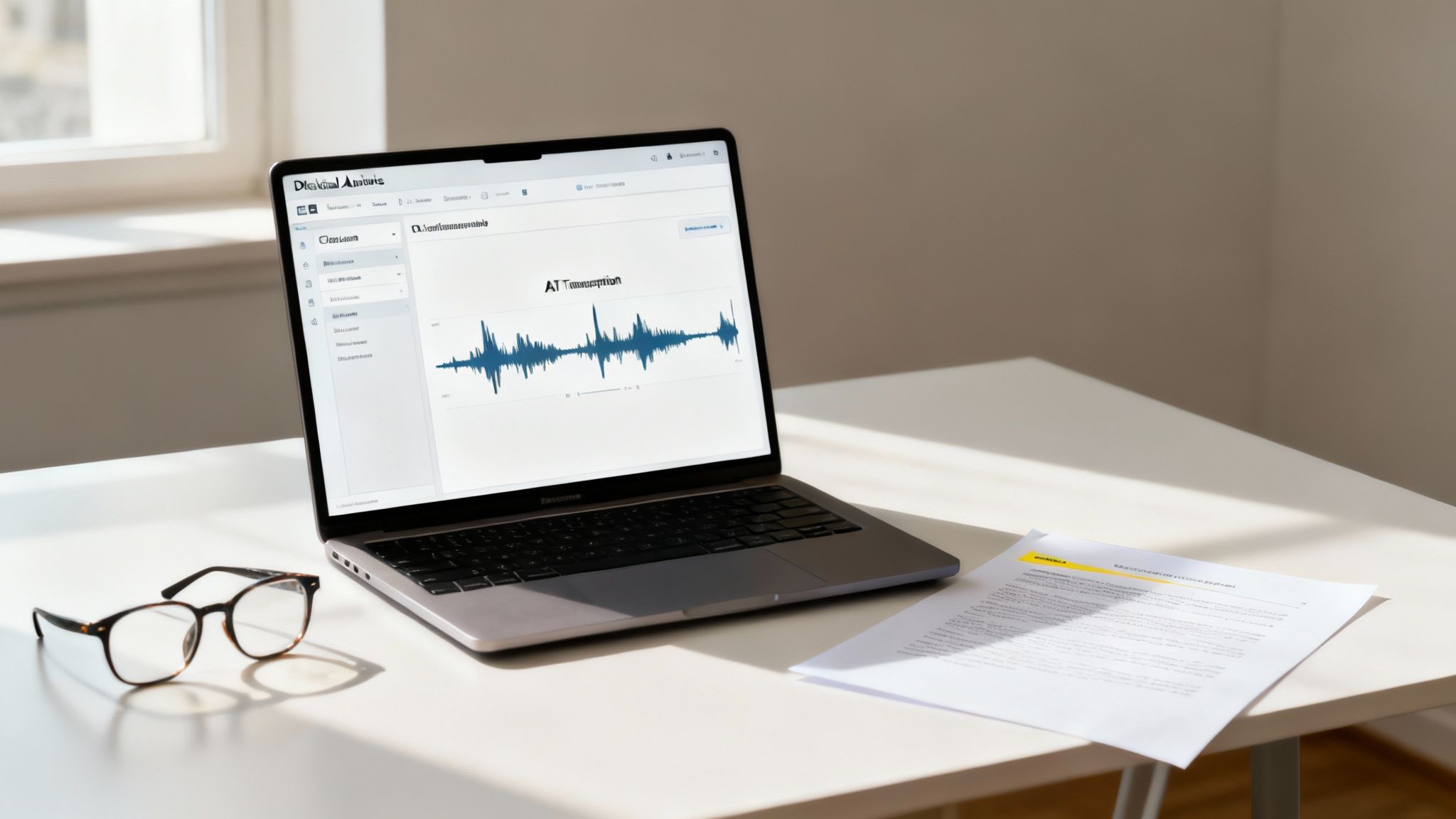
AI doesn't replace your critical thinking; it just handles the grunt work so you have more time to actually think. It’s like having a tireless research assistant who never needs a coffee break.
Imagine you've found a goldmine of handwritten letters or scanned PDF documents. Instead of squinting at the screen for hours, you can use Zemith to instantly transcribe them into clean, searchable text. This isn't just a time-saver; it’s a project-saver. For tips on dealing with stubborn PDFs, check out our guide on .
But modern AI goes way beyond simple transcription. It can help you:
- Summarize Dense Reports: Upload a lengthy government document and get a concise summary of the key points in seconds.
- Identify Key Themes: Analyze thousands of pages to spot recurring themes, names, and places you might have otherwise missed.
- Translate Sources: Instantly translate documents from other languages, dramatically broadening your research scope.
When you bring these tools into your process, you're not just speeding things up—you're unlocking a much deeper level of analysis. You can spend less time on manual labor and more time connecting the dots, which is where you'll find those hidden stories that make historical research so incredibly rewarding.
Common Questions About Primary Source Analysis
You’ve made it this far, which means you're well on your way to thinking like a true primary source detective. But every good investigation brings up more questions. Let's tackle some of the most common hurdles and curiosities that pop up when you're just getting started.
Think of this as your personal Q&A session, designed to turn those stuck moments into "aha!" moments.
What Is the Difference Between a Primary and a Secondary Source?
This is the big one. It's the question I get more than any other, and for good reason—getting this right is the foundation for everything else.
A primary source is the raw material of history. It’s a firsthand account or an artifact created during the time period you’re studying by someone who was there. It's the "eyewitness" to the event.
A secondary source, on the other hand, is a step removed. It’s someone analyzing, interpreting, or commenting on those primary sources long after the fact. Think of it as someone commenting on what the eyewitness saw.
Still a bit fuzzy? Let’s make it concrete.
- Primary Source Examples: A soldier's diary from World War I, an original patent filing, a photograph of the Civil Rights March on Washington, or a government census record from 1920.
- Secondary Source Examples: A textbook chapter about World War I, a biography of an inventor, a documentary on the Civil Rights Movement, or a historian’s article analyzing population shifts using census data.
Here's a simple mental shortcut: Ask yourself, "Was the creator there?" If the answer is yes, you're almost certainly looking at a primary source. If they're talking about something that happened in the past based on research, it's secondary.
How Should I Handle a Source That Is Obviously Biased?
First off, finding bias isn't a problem—it’s a victory! It means you're looking at the source with a critical eye, which is exactly what you should be doing. A biased source is not a useless source. In fact, it can be an absolute goldmine.
Don't just toss it aside. Instead, treat the bias itself as another piece of evidence.
Start digging deeper with a few more questions:
- Why is the author biased? What beliefs, motivations, or circumstances might have shaped their perspective?
- What does their bias reveal? A piece of wartime propaganda is a terrible source for objective facts, but it’s an amazing source for understanding what a government wanted its citizens to believe.
- Who were they trying to convince? Bias is often a tool for persuasion. Figuring out the intended audience tells you a lot.
The key is to never let a biased source stand on its own. You absolutely have to corroborate its claims by checking them against other documents. You can even use a tool like Zemith to compare claims across multiple texts. It can automatically flag potential contradictions, making it way easier to see where one source’s story starts to veer off from the others.
Is It Okay to Use Wikipedia for My Research?
Ah, the classic question. This is a "yes, but..." situation. Let's be clear: you should never cite Wikipedia as a core source in an academic paper. Your professors will cringe, and your credibility will vanish.
However, that doesn't mean it's useless. Far from it.
Think of Wikipedia as a fantastic launching pad. It's a great place to get a general overview, identify the key people and events, learn the basic vocabulary, and get a feel for the timeline.
Here’s the pro move: after you've used an article to get your bearings, scroll all the way down to the "References" and "External Links" sections. That’s the real treasure. You'll find direct links to the scholarly articles, primary documents, and reputable secondary sources the Wikipedia entry is built on.
So, the rule of thumb is simple: use Wikipedia to find your sources, not to be your source.
What Are the Most Common Mistakes to Avoid?
Learning how to analyze primary sources is a skill, and like any skill, there are some common pitfalls. Just knowing what they are is half the battle.
Here are the big three that can easily trip people up:
- Taking a Source at Face Value: This is the cardinal sin of source analysis. Never, ever assume a document is telling the whole, unvarnished truth. Always question the creator, their purpose, and the context.
- Cherry-Picking Evidence: This happens when you only grab the parts of a source that confirm what you already think, while conveniently ignoring anything that complicates your argument. Good analysis embraces the messiness.
- Making Grand Generalizations: One soldier's letter doesn't speak for the entire army. A single source is a single data point. It's a vital clue, but you need a lot of clues to build a solid case.
One last procedural mistake can cause major headaches down the road: forgetting to cite your sources as you go. It's tedious, I know, but it’s essential for academic integrity and saves you from a world of pain later. For a deeper dive on this, our guide on is a lifesaver.
By staying curious and always asking, "What's the other side of this story?" you'll sidestep these traps and produce a much richer, more accurate analysis.
Ready to put these skills into practice with a powerful AI assistant by your side? Zemith is your all-in-one platform for deep research. Summarize dense documents, transcribe handwritten notes, and cross-reference sources in a fraction of the time. Stop juggling multiple tools and start analyzing with focus and clarity. Discover a smarter way to work at .
Explore Zemith Features
Every top AI. One subscription.
ChatGPT, Claude, Gemini, DeepSeek, Grok & 25+ more


Always on, real-time AI.
Voice + screen share · instant answers
What's the best way to learn a new language?
Immersion and spaced repetition work best. Try consuming media in your target language daily.
Voice + screen share · AI answers in real time
Image Generation
Flux, Nano Banana, Ideogram, Recraft + more

Write at the speed of thought.
AI autocomplete, rewrite & expand on command
Any document. Any format.
PDF, URL, or YouTube → chat, quiz, podcast & more
Video Creation
Veo, Kling, Grok Imagine and more

Text to Speech
Natural AI voices, 30+ languages
Code Generation
Write, debug & explain code
Chat with Documents
Upload PDFs, analyze content
Your AI, in your pocket.
Full access on iOS & Android · synced everywhere
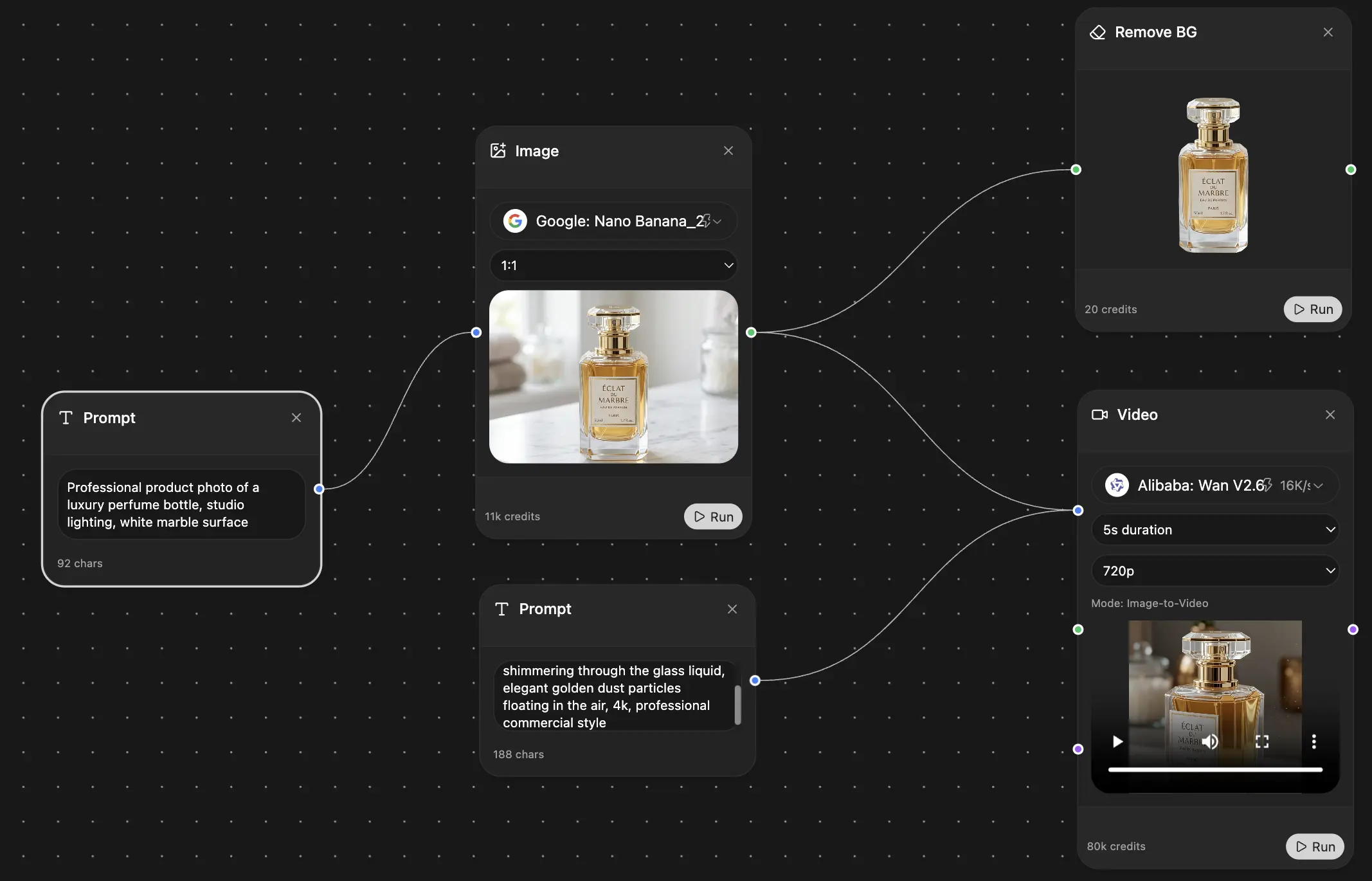
Your infinite AI canvas.
Chat, image, video & motion tools — side by side
Save hours of work and research
Transparent, High-Value Pricing
Trusted by teams at


Free
No credit card required
- 100 credits daily
- 3 AI models to try
- Basic AI chat
Plus
- 1,000,000 credits/month
- 25+ AI models — GPT, Claude, Gemini, Grok & more
- Agent Mode with web search, computer tools and more
- Creative Studio: image generation and video generation
- Project Library: chat with document, website and youtube, podcast generation, flashcards, reports and more
- Workflow Studio and FocusOS
Professional
- Everything in Plus, and:
- 2,100,000 credits/month
- Pro-exclusive models (Claude Opus, Grok 4, Sonar Pro)
- Motion Tools & Max Mode
- First access to latest features
- Access to additional offers
What Our Users Say
Great Tool after 2 months usage
"I love the way multiple tools they integrated in one platform. Going in the right direction."
— simplyzubair
Best in Kind!
"The quality of data and sheer speed of responses is outstanding. I use this app every day."
— barefootmedicine
Simply awesome
"The credit system is fair, models are perfect, and the discord is very responsive. Quite awesome."
— MarianZ
Great for Document Analysis
"Just works. Simple to use and great for working with documents. Money well spent."
— yerch82
Great AI site with accessible LLMs
"The organization of features is better than all the other sites — even better than ChatGPT."
— sumore
Excellent Tool
"It lives up to the all-in-one claim. All the necessary functions with a well-designed, easy UI."
— AlphaLeaf
Well-rounded platform with solid LLMs
"The team clearly puts their heart and soul into this platform. Really solid extra functionality."
— SlothMachine
Best AI tool I've ever used
"Updates made almost daily, feedback is incredibly fast. Just look at the changelogs — consistency."
— reu0691