


Every top model, with tools built in.
Search the web, run deep research, read files, create images and run code with GPT, Claude, Gemini, Grok and more.
Facing digital transformation challenges? Discover practical steps, tips, and proven strategies to steer your business toward measurable impact.
Let's be honest. The toughest hurdles in any digital transformation aren't just about the tech—they’re about the people, the ingrained habits, and the creaky old systems holding everything together with digital duct tape. True success means getting past deep-seated cultural resistance, gaps in leadership, and the nightmare of messy data integration. These are the digital transformation challenges that consistently trip up even the most well-funded projects.

Does your big digital initiative feel like a nerve-wracking game of Jenga? You map out every move with precision, but you know that pulling the wrong block—whether it’s a decades-old legacy system or a team digging in their heels against change—could send the whole thing crashing down. If that sounds familiar, you're not alone.
This guide cuts through the corporate buzzwords to get to the heart of why so many great strategies stall out. It’s almost never one big, dramatic failure. Instead, it’s usually a slow burn caused by a series of small, interconnected problems that build friction and grind progress to a halt.
Digital transformation doesn’t stop. One digital transformation necessitates another. Waves coming so fast they start to pass each other, amplify each other. A perfect storm of challenge and opportunity.
Let's take an honest look at the common culprits that gum up the works. Think of this as your field guide to the obstacles ahead before we dive into the specific solutions for clearing them.
Before we dig deeper, let's get a high-level view of where things most often go wrong. Recognizing these common roadblocks is the first step toward building a strategy that can actually navigate them. A well-defined strategic planning process is your best defense, helping you spot these icebergs before they sink the ship.
These are the big ones we see time and time again. Each one has the power to derail your efforts if left unaddressed, but tackling them head-on is what separates successful transformations from expensive failures.
Making your way through this maze requires more than just shiny new software; it calls for an entirely new way of thinking and working. As you build your roadmap, remember that having dedicated implementation support can be the difference-maker.
The whole point of this guide is to help you turn that chaos into clarity. We’ll break down how a unified AI platform like Zemith can become your mission control. By bringing research, content, and team collaboration into a single, cohesive workspace, it smooths out those complex workflows. This isn't just about overcoming obstacles—it's about turning those roadblocks into runways for real, lasting growth.
Let's dive in.

Let's talk about the elephant in the server room: the people. You can buy the fanciest tech on the planet, but if your team isn't on board, you’ve just bought a very expensive paperweight. Technology is often the easy part; changing human behavior is the final boss battle of any major initiative.
These thorny cultural and organizational digital transformation challenges are painfully easy to overlook until they’ve already derailed your project. It’s like trying to get your entire company to agree on a pizza topping—nearly impossible without a solid strategy and a lot of communication.
Employee resistance isn't just stubbornness. It often stems from a genuine fear of the unknown. People worry about their roles becoming obsolete, the discomfort of learning new systems, and a lack of understanding about why this massive change is even necessary.
When employees feel that change is happening to them instead of with them, they’ll naturally dig in their heels. The secret is turning the initiative from a top-down mandate into a shared mission.
This resistance is one of the most significant barriers to success. A critical aspect of solving these people problems is learning how to reduce employee turnover with practical strategies, especially when navigating large-scale changes that can make valued team members feel insecure.
Another major hurdle is leadership misalignment. If the C-suite isn't visibly and consistently championing the transformation, why should anyone else care? A lack of leadership support sends a clear message that the project isn't a real priority.
This often happens for a few key reasons:
Effective leadership means more than just approving a budget. It involves actively removing obstacles, building coalitions between departments, and modeling the new behaviors you want to see from the rest of the organization.
So, how do you get everyone rowing in the same direction? It starts with communication and collaboration. You need to foster a culture of innovation where people feel safe to experiment and even fail without fear of retribution.
Empowering teams is crucial. Instead of just handing down orders, give them the tools and autonomy to solve problems. This is where modern collaborative platforms become your secret weapon. For instance, using a tool like Zemith's collaborative Whiteboard allows teams to brainstorm and visualize new workflows together, giving everyone a stake in the outcome.
By organizing initiatives in a shared workspace like Zemith's Projects, you can centralize all communication, documents, and progress updates. This transparency helps bridge communication gaps, ensures everyone is on the same page, and builds trust. The best part? When people feel heard and involved, resistance melts away.
Ultimately, overcoming the people-centric digital transformation challenges requires a shift from managing technology to leading people. When you successfully communicate the 'why,' empower your teams with the right tools, and lead with visible commitment, you can turn your biggest skeptics into your most passionate champions.
You’ve got the vision, a solid budget, and leadership is finally on board. So, what could possibly go wrong? Well, there's a tiny little problem: who is actually going to use all this fancy new tech? A massive, and frankly, often underestimated challenge in any digital transformation is the widening digital skills gap.

It’s tougher than ever to find people who are fluent in the technologies driving modern business. This isn't just an IT problem that lives in the server room; it hits every single department, from marketing to finance. When you don't have the talent to operate the tools, your multi-million dollar investment can quickly become a digital doorstop.
The demand for specialized digital skills is skyrocketing, while the supply of qualified talent struggles to keep up. It’s a classic supply-and-demand problem, except this one can bring your entire transformation strategy to a grinding halt. Old-school, one-off training seminars just aren’t cutting it anymore.
The most sought-after skills today include:
Without these capabilities in-house, companies are left vulnerable and simply can't capitalize on their technology investments.
Finding a data scientist can feel like searching for a unicorn that also knows how to code in Python. The talent is out there, but it's rare, in high demand, and expensive.
The numbers really paint a stark picture. A whopping 27% of senior leaders point to gaps in technical talent as a primary roadblock to their digital initiatives. Looking ahead, some projections even warn that up to 90% of organizations could face IT talent shortages by 2026. This isn't just an inconvenience; it could translate to $5.5 trillion in global losses from unaddressed skills gaps. For a deeper dive into these trends, check out the full digital transformation research from Backlinko.
So what’s the fix? Getting into a bidding war for a handful of elite experts isn't a sustainable strategy for most companies. The smarter move is to empower the team you already have. You do that by giving them tools that make advanced technology accessible to everyone, regardless of their technical background.
This is where democratizing technology becomes a game-changer. Instead of needing a PhD in data science to analyze a report, what if your marketing manager could get the same insights with a simple prompt? This is how you close the skills gap from the inside out. By adopting platforms that lower the barrier to entry, you effectively upskill your entire workforce on the fly. It's also a great idea to explore some new collaborative learning strategies that can help your team grow together.
For instance, an integrated AI platform like Zemith is designed to solve this exact problem. Its Coding Assistant empowers junior developers to write complex code and debug faster, reducing their reliance on senior engineers. This accelerates development cycles without forcing everyone to become an expert in every new framework.
Meanwhile, the Document Assistant allows a non-technical user in the finance department to ask complex questions about dense financial reports and get instant, accurate summaries. They don't need to learn a new analytics program; they just need to ask a question. This approach turns a critical weakness—the skills gap—into a strategic strength by making everyone more capable.
Welcome to the tech jungle. This is where we tackle one of the gnarliest challenges in any digital transformation: that tangled, messy world of technology and data. You know what I'm talking about—those ancient legacy systems chugging along in a dark server room, basically held together by duct tape and a prayer.
Then you have the modern-day headache of trying to get a dozen different software tools to play nice, but they absolutely refuse to speak the same language. It feels like you're trying to build a smart home using a VCR, a dial-up modem, and a fax machine. It's a mess, and it’s definitely holding you back.
This knotted web of old and new systems, which we affectionately call "tech spaghetti," creates huge problems that go way beyond simple frustration. When your systems can't talk to each other, you end up with data silos. These are isolated islands of information that make it impossible to see the big picture.
This leads to a few pretty painful outcomes:
The constant firefighting required to manage this complex setup just burns through time and money that you should be spending on innovation. You get stuck in a loop of just trying to keep the lights on instead of actually moving forward.
So, why not just tear everything out and start over? If only it were that simple. A full "rip and replace" is usually way too expensive and incredibly disruptive to the business. For most companies, the answer isn't a total teardown but a smarter, more practical integration plan.
But getting different systems from different vendors—and even different decades—to work together is a massive undertaking. It almost always requires custom code, pricey middleware, and a team of developers who understand both the ancient and the new tech. This is where so many projects grind to a halt, drowning in technical debt and unexpected roadblocks.
Think of it like a plumbing job in an old house. You might only want to replace a faucet, but you soon discover the pipes are a mix of copper, PVC, and lead from three different eras. A simple fix suddenly becomes a massive project.
This is a classic spot where a consolidated platform can be a total lifesaver. Instead of trying to connect ten different tools, what if you could replace five of them with a single, integrated solution?
This is precisely where an all-in-one platform like Zemith comes in to solve a huge piece of the puzzle. It was built to cut through the chaos by bringing critical functions into one cohesive workspace, turning your tech spaghetti into a streamlined, high-performance system.
Imagine your team needs to use the latest AI models for different tasks. Instead of subscribing to and trying to integrate multiple services, Zemith gives them direct access to leading models like Gemini, Claude, and GPT-4o all from one simple interface. No more jumping between apps, no more API juggling, and no more fragmented data. Want to dig deeper into this? Check out our article on effective research data management.
By bringing AI assistants, creative tools, deep research functions, and collaborative projects under one roof, Zemith slashes the number of moving parts your IT team has to worry about. It simplifies your tech stack, lowers your security risks, and makes sure your data lives in one place where it can actually be used to make smart decisions. This approach doesn't just fix a technical problem; it builds a more efficient and powerful foundation for your entire digital strategy.
Okay, we’ve stared down the major roadblocks that can derail a digital transformation. Now comes the fun part: creating a game plan to actually get things done. This is where we shift from identifying problems to building a practical strategy to solve them.
Think of this action plan as your project’s GPS. It’s designed to give you turn-by-turn directions, guiding you from the initial idea all the way to a successful launch. Without a clear map, even the best intentions get lost.
Here’s a hard truth: not all digital projects are created equal. If you try to do everything at once, you’re just signing up for chaos and burnout. The real first step is figuring out which projects will deliver the most bang for your buck. Focus on those high-impact, high-visibility wins first.
A great way to start is by finding the biggest pain points in your organization. Are your sales reps wasting hours every day on manual data entry? Is your customer service software a relic from a bygone era? Solving a real, tangible problem builds momentum and gets people excited about what’s next. A SWOT analysis is a fantastic tool for this, and you can learn more about how to conduct a SWOT analysis in our detailed guide.
You can have the most brilliant plan in the world, but if the leadership team isn’t on board, it’s dead in the water. Getting executive buy-in isn't just about a slick presentation; it’s about building a rock-solid business case. You need to speak their language—the language of results.
Forget fuzzy buzzwords. Talk about hard numbers they can't ignore:
When you can clearly connect your digital goals to the company's bottom line, you're not just asking for a budget—you're presenting an investment opportunity they can't afford to miss.
How will you know if you're actually winning? You need clear, measurable goals from day one. Vague ambitions like "improve efficiency" just don't cut it. You have to get specific. Your Key Performance Indicators (KPIs) should be directly tied to the problems you set out to solve.
For example:
The process flow below shows the journey from tangled legacy systems to a streamlined, modern operation.
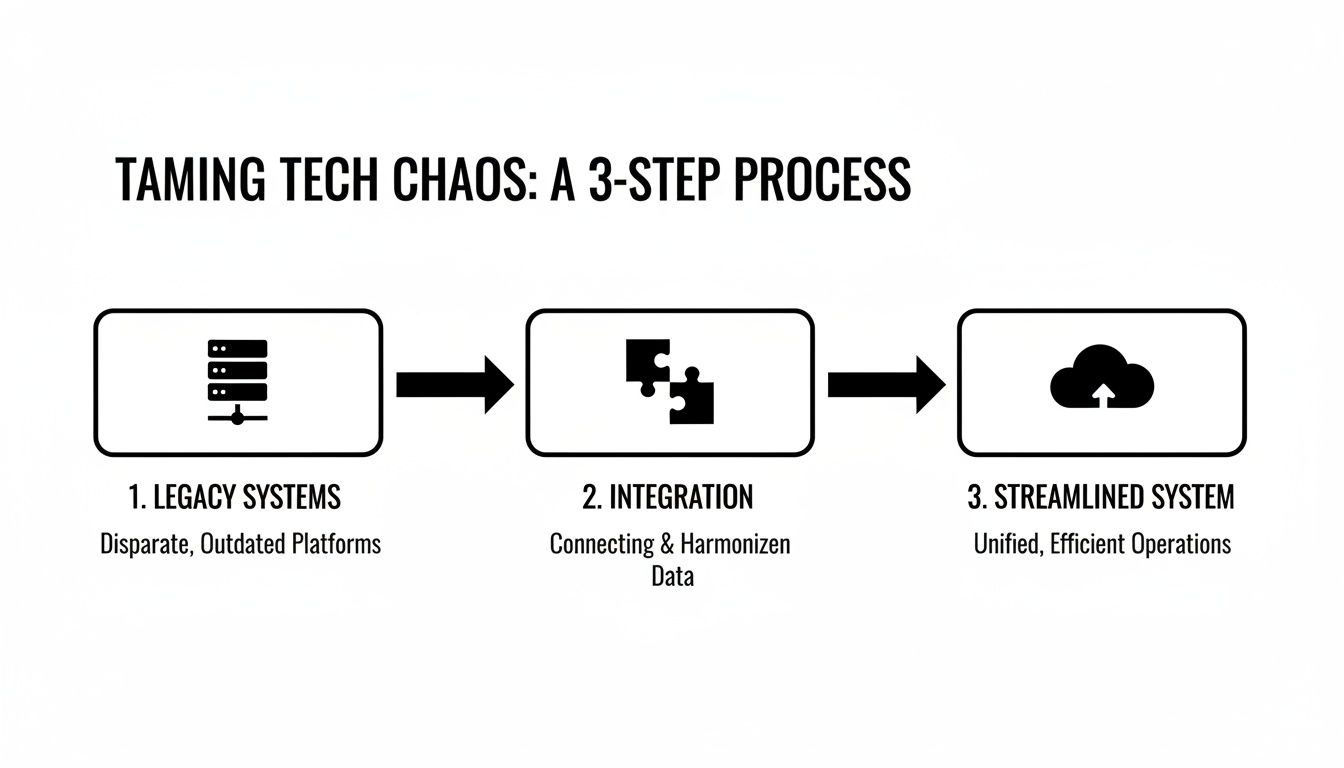
This diagram drives home a key point: successful transformation isn't about flipping a switch overnight. It’s a deliberate process of integrating the new with the old. By creating a unified plan, you build a foundation where every department—from marketing to development—can contribute to and benefit from a more agile, data-driven company.
We’ve really dug into the nitty-gritty of digital transformation, from navigating a maze of mismatched tech to tackling the very human hurdles that can derail a project. Before we wrap up, let’s go over some of the most common questions that come up when businesses start this journey for real.
Think of this as your personal FAQ for when things get complicated.
It's tempting to point fingers at buggy software or budget cuts, but if you ask anyone who's been through it, they'll tell you the real monster is cultural resistance. Honestly. It’s not about the code; it’s about the people. You can almost always throw enough money and time at a technical problem to fix it.
But getting your entire organization to change how they work every single day? That’s a whole different ballgame. You're dealing with deep-seated habits and real human fears—employees worrying their jobs are on the line, managers afraid of losing control. If you don't tackle this head-on with clear communication and leadership that actually leads by example, the best tech in the world will just gather dust. Building a culture that's ready for change isn't just a "nice-to-have"; it's the bedrock of the whole operation.
Small businesses often see these massive challenges and think, "There's no way we can keep up." They're working with less cash and smaller teams, but they have a superpower the big guys don't: agility.
Unlike corporate giants that move at a glacial pace, a small business can turn on a dime. The secret is to stop thinking about a massive, all-at-once overhaul and start focusing on small, smart wins.
Here's a simple playbook:
A small business doesn't need to boil the ocean. The goal is to make one perfect cup of tea, then another, and another. Those small, consistent victories build unstoppable momentum.
Trying to measure the Return on Investment (ROI) of a digital transformation project can feel like trying to weigh a cloud. If you only look at profit and loss, you’re missing half the picture. The real value is so much bigger than that.
Sure, cost savings are a piece of it, but you need to track a mix of metrics to see what’s really happening:
With a platform like Zemith, you can get super specific. You could track the hours your research team saves by using its Deep Research tool, or you could calculate how much faster your marketing team is shipping campaigns. When you combine those operational wins with the financial numbers, you get a true 360-degree view of your success.
Ready to stop wrestling with these challenges and start using them to your advantage? Zemith brings the power of dozens of AI tools into one clean workspace, so your team can research faster, create smarter, and work together without the friction. It's time to ditch the subscription chaos and start building what's next.
Explore how Zemith can accelerate your success at zemith.com


Trusted by teams at


The top models, plus image, video and voice tools, in one plan.
Without Zemith
ChatGPT PlusUS$20.00Claude ProUS$20.00Google AI ProUS$19.99SuperGrokUS$30.00Perplexity ProUS$20.00 MidjourneyUS$10.00
 ElevenLabsUS$6.00Le Chat ProUS$14.99
 RunwayUS$15.00Kling StandardUS$8.80
 Gamma PlusUS$12.00
 Otter ProUS$16.99
 QuillBot PremiumUS$19.95
 Photoroom ProUS$12.99
 Quizlet PlusUS$7.99
Total if paying separatelyUS$234.70/mo
"I love the way multiple tools they integrated in one platform. Going in the right direction."
— simplyzubair
"The quality of data and sheer speed of responses is outstanding. I use this app every day."
— barefootmedicine
"The credit system is fair, models are perfect, and the discord is very responsive. Quite awesome."
— MarianZ
"Just works. Simple to use and great for working with documents. Money well spent."
— yerch82
"The organization of features is better than all the other sites — even better than ChatGPT."
— sumore
"It lives up to the all-in-one claim. All the necessary functions with a well-designed, easy UI."
— AlphaLeaf
"The team clearly puts their heart and soul into this platform. Really solid extra functionality."
— SlothMachine
"Updates made almost daily, feedback is incredibly fast. Just look at the changelogs — consistency."
— reu0691
Hand off the research, writing, design and follow-ups. Zemith picks the tools it needs and brings back finished work.
Search the web, run deep research, read files, create images and run code with GPT, Claude, Gemini, Grok and more.
Zemith keeps working in the cloud and pings you when it's done.
Notion, Linear, Canva, Airtable and more. It asks before it creates or changes anything.
Docs, slides, sheets and PDFs, ready to send.
Chain models and tools on a visual canvas, from one prompt to a finished promo video.
Briefings, reports and reminders run on a schedule and are ready when you need them.
Real-time voice that can see your camera or screen.
The best image and video models, in one studio.
Turn PDFs, links and YouTube videos into podcasts, quizzes, flashcards and mind maps.


 Podcast
 Quiz
Quiz Flashcards
 Mind map
 Infographic