Claude 3.5 Sonnet vs GPT-4o: The Ultimate AI Smackdown
Claude 3.5 Sonnet vs GPT 4o: An honest comparison of coding, reasoning, and creative skills to help you pick the right AI for your workflow.
When you're trying to decide between Claude 3.5 Sonnet vs GPT-4o, it's a bit like choosing between a brilliant, deeply focused research scientist and a witty, lightning-fast polymath who can juggle chainsaws. If your day is filled with deep research, complex reasoning, or untangling documents longer than a CVS receipt, Sonnet is your powerhouse. On the other hand, if you need a quick, versatile assistant that can jump between text, images, and audio, GPT-4o is the jack-of-all-trades you're looking for.
The Unfiltered AI Heavyweight Matchup
Alright, let's get right to it. In one corner, we have Anthropic's new brainiac, Claude 3.5 Sonnet, which boasts some serious graduate-level reasoning skills. In the other corner stands OpenAI's incredibly versatile champion, GPT-4o, famous for its lightning speed and ability to handle just about any media you throw at it.
We’re going to skip the marketing fluff and give you a straight-up guide on which AI to pick for the job at hand. This is especially important for anyone using an integrated platform like Zemith, where choosing the right model can make a massive difference in your workflow's efficiency. The goal isn't just to pick a "winner," but to build your own personal AI dream team.
This isn't just about comparing specs on a sheet; it's about finding the right tool for your specific projects. While we have a broader guide to the available, this piece is all about this head-to-head battle.
A Quick Look At Sonnet vs GPT-4o
Before we dive deep, let's start with a high-level comparison. This table is your cheat sheet to see where each model pulls ahead, giving you a quick sense of their core strengths.
So, what do the numbers say? When it comes to pure reasoning, the benchmarks tell a compelling story. Claude 3.5 Sonnet is consistently edging out GPT-4o in tests that measure complex, graduate-level thinking.
For instance, on the tough GPQA benchmark, Sonnet scored an impressive 59.4%, leaving GPT-4o’s 53.6% a fair bit behind. You can if you want to get into the weeds of the data. For ongoing insights and trends, a good is always a great resource.
How Raw Performance Benchmarks Affect Your Work
Let's pop the hood and see what these engines are really made of. Benchmarks can sound a bit academic, but they're the best way to get a real feel for an AI's horsepower. We need to look past the marketing hype and dig into what scores from tests like GPQA, MMLU, and HumanEval actually mean for your day-to-day grind.
When you put Claude 3.5 Sonnet vs GPT-4o head-to-head, the differences aren't just tiny percentage points; they reveal specialized strengths. It turns out Claude 3.5 Sonnet has taken a surprising lead in complex reasoning, while GPT-4o holds its ground as a powerhouse, especially for coding.
But what does that mean for you in practice? Let's translate these abstract numbers into real-world results you can actually use.
Graduate-Level Reasoning: The Sonnet Advantage
The big headline here is Sonnet's performance on graduate-level reasoning. This isn't just about acing a trivia quiz. It’s about the AI’s ability to grasp nuance, understand context, and see the intricate connections between different ideas. Think of it as the difference between memorizing facts and truly understanding a concept.
The GPQA (Graduate-Level Google-Proof Q&A) benchmark is a real eye-opener. It's built to test an AI on problems so tough that even PhD-level experts have to pause and think. On this test, Sonnet hits a score of 59.4%, which is a solid jump from GPT-4o's 53.6%.
This chart really puts that reasoning gap into perspective.
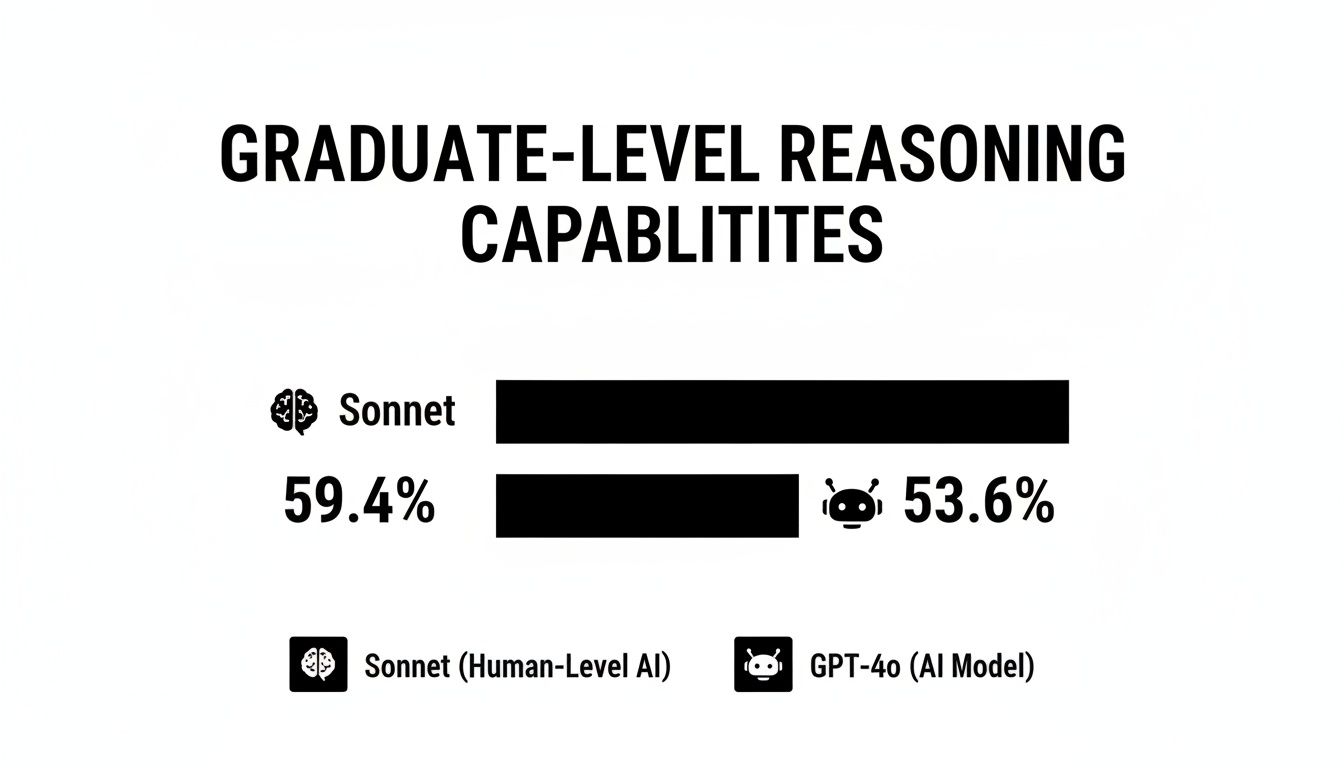
The data makes it pretty clear: Sonnet has an edge when it comes to tasks that demand deep, analytical thinking.
For a Zemith user, this translates directly to getting better, more insightful results. Let's say you're using our Deep Research tool for a competitor analysis. A model with stronger reasoning can:
- Spot Subtle Threats: It can connect the dots between a competitor’s new patent filing and a vague press release, flagging a potential market shift that a less sophisticated model would completely miss.
- Synthesize Complex Data: Instead of just spitting back summaries of articles, it can chew on financial reports, customer reviews, and market trends to deliver a cohesive strategic overview.
- Truly Understand Your Prompts: An AI with better reasoning is much better at understanding the intent behind your words, not just the words themselves. This is a huge part of getting great outputs, and you can dive deeper into this in our guide on .
The Key Takeaway: Sonnet's superior reasoning isn't just a number on a chart. It’s a real, practical advantage for any work that involves strategy, critical analysis, or making sense of complex, multi-layered information.
Coding Prowess: Where GPT-4o Still Shines
While Sonnet is flexing its reasoning muscles, GPT-4o continues to be an absolute beast in the coding arena. On the HumanEval benchmark, which tests an AI's knack for writing correct, functional code from scratch, both models are top-tier. But in my experience, GPT-4o often feels faster and more direct for common developer tasks.
It's fantastic at churning out code snippets, helping you debug tricky functions, and providing quick, accurate code completions. Think of it as the ultimate pair programmer for your day-to-day development sprints.
Inside Zemith's Coding Assistant, this plays out perfectly. A developer working on a new feature can lean on GPT-4o to rapidly prototype a React component, get instant feedback on a tricky SQL query, or translate a block of Python into JavaScript. Its speed and accuracy in these everyday situations are a massive help, cutting down on friction and keeping the development cycle moving.
To make things clearer, let's break down how these benchmark scores translate into practical strengths.
Key Benchmark Scores: A Side-by-Side Analysis
This table lays out the scores from some of the most important industry tests, giving you a quick look at where each model leads and what that means for your specific needs.
Ultimately, these benchmarks are the "why" behind an AI's behavior. Sonnet's high reasoning score is the reason it’s so good at untangling complex reports in Zemith. At the same time, GPT-4o's solid coding performance is why it can help you build and debug software so effectively.
Choosing Your AI Copilot For Coding Tasks
Alright developers, let's get into it. When you're buried in code, you don’t just need an AI that can regurgitate Stack Overflow answers. You need a real partner—one who gets the bigger picture and helps you stay in the flow.
We're pitting Claude 3.5 Sonnet vs GPT-4o against each other in a real-world coding showdown. Forget the sterile benchmarks for a second. This is about which model you can actually trust when you're facing down your gnarliest technical problems.
The Need For Speed vs. The Need For Depth
The first big question in AI-assisted coding is whether you need speed or context. GPT-4o is blazing fast, which makes it an incredible tool for quick, iterative development. Think of it as that senior dev who can glance over your shoulder and instantly spot a syntax error or whip up some boilerplate.
On the flip side, Claude 3.5 Sonnet's real power is its deep reasoning. It’s much better at understanding the entire architecture of a project. If you're wrestling with a spaghetti mess of dependencies or trying to refactor a monolithic legacy app, Sonnet’s ability to see the forest for the trees gives it a serious edge.
Let's say you're debugging a tricky React component right inside Zemith's Coding Assistant. Here’s how that plays out:
- GPT-4o: You need a new state hook, and you need it now. You ask GPT-4o, and bam—a clean, working snippet appears in seconds. It’s perfect for keeping your momentum during live previews and rapid prototyping.
- Claude 3.5 Sonnet: That same component is bogging down the whole app. Instead of just fixing a line, Sonnet can analyze how it interacts with everything else, pinpoint inefficient data flows, and suggest a more thoughtful refactor that solves the root problem.
For developers, the choice often comes down to this: Do you need an AI that can sprint with you on small tasks, or one that can run a marathon through your entire codebase?
Generating and Explaining Complex Code
Now for the tasks that make you question your life choices—like writing a monstrous SQL query with multiple joins or trying to make sense of legacy code with zero comments. We’ve all been there.
This is where Sonnet often shines. Its advanced reasoning helps it untangle convoluted logic and explain the why behind the code, even when the original developer's choices were... creative. It's not just about generating correct code, but code that's also efficient and readable.
For instance, if you feed both models a terrifyingly old Perl script, GPT-4o will give you a solid line-by-line breakdown. Sonnet, however, is more likely to infer the original developer's intent and propose a modern, maintainable Python equivalent. For a deeper dive on this, check out our guide on the .
Modern Frameworks and Real-World Examples
When it comes to modern frameworks like Next.js, Vue, or Svelte, both models are more than capable. But they do have slightly different strengths.
GPT-4o's Strength: It’s often faster on the uptake with the latest syntax and patterns, thanks to its massive and constantly updated training data. If you want a component that follows the absolute latest best practices, it's a great choice.
Sonnet's Strength: It’s better at figuring out how a new piece of code should fit into your existing complex system. It’s less prone to suggesting a change that, while technically cool, might create unintended side effects down the line.
Here’s a quick breakdown for common coding jobs:
At the end of the day, both are fantastic tools. GPT-4o is your go-to for the fast-paced, everyday coding grind, while Sonnet is the specialist you bring in for the heavy-duty, architectural thinking.
Finding The Spark For Creative And Content Work
If you're a writer, marketer, or content creator, this is where the rubber meets the road. Sure, an AI can string words together, but can it write with personality? Can it find that creative spark? Let's get into a qualitative showdown between Claude 3.5 Sonnet vs GPT-4o to see which one makes a better creative partner.
This isn't just about nailing grammar and syntax. It’s about capturing a specific voice, understanding tricky brand guidelines, and coming up with ideas that feel fresh—not just scraped from the top ten search results. The real test is whether you can avoid the dreaded "this was definitely written by an AI" vibe.
The Nuance of Voice and Tone
Maintaining a consistent tone of voice is notoriously difficult for most AI models. They'll often start a blog post with a witty, casual vibe and finish it sounding like a stuffy academic paper. This is where the core reasoning abilities of each model really get put to the test.
From what I’ve seen, Claude 3.5 Sonnet has a slight edge here. It seems to have a better grasp of subtle stylistic instructions, almost like it understands the why behind a brand's voice. You can feed it a complex set of guidelines—"be professional but not stuffy, witty but not goofy, confident but not arrogant"—and it does a surprisingly good job of hitting that sweet spot.
is also fantastic, particularly for generating punchy, high-energy marketing copy. It’s a beast when it comes to crafting snappy headlines and social media blurbs that demand attention. The only catch is that it can sometimes default to generic "marketing speak" if you aren't super precise with your prompts.
The Content Creator's Insight: For long-form content where a unique, nuanced personality is crucial, Sonnet often feels more like a seasoned writer. For quick, punchy copy that needs to make an immediate impact, GPT-4o is an absolute workhorse.
From Brainstorm to Polished Draft
Alright, let's talk about the messy middle of content creation. You’ve got a jumbled list of bullet points, a half-formed idea, or a paragraph that just isn't landing right. Which AI is better at turning that chaos into something polished? This is where an integrated tool like Zemith's Smart Notepad becomes your command center.
Here, you can really see how a unified platform helps you manage the entire creative process, from that first spark of an idea to the final, polished draft.
This screenshot shows the kind of clean, integrated workspace that lets you flip between models and tools without breaking your flow.
Working this way lets you directly compare how each model tackles the same task. For instance, when I feed the same messy list of bullet points to both models inside Zemith, their core strengths become immediately obvious.
- GPT-4o is all about efficiency. It will quickly organize your points into a logical, well-structured article that’s pretty much ready to go. It's pragmatic and gets the job done fast.
- Sonnet often takes a more creative route. It might find a unique angle or a narrative thread to tie the points together, which can lead to a more engaging and original piece.
It's the same story when you ask them to rephrase a clunky paragraph. GPT-4o excels at simplifying the language and improving the flow. Sonnet, on the other hand, often injects a bit more personality and warmth, making the text feel less like it was written by a committee. For anyone serious about elevating their creative output, exploring a range of can really open up new possibilities.
Generating Genuinely Original Ideas
Finally, let's touch on originality—the holy grail for any creative professional. Can an AI actually give you a new idea, or is it just a master at remixing what already exists?
GPT-4o is a brainstorming machine. If you need fifty blog post titles, it'll spit out fifty solid options in a matter of seconds. Think of it as a creativity firehose.
, however, seems to shine in more conceptual brainstorming. It’s better at tackling "what if" scenarios and connecting seemingly unrelated ideas. If you're stuck on a big-picture campaign concept, Sonnet might be the one to help you find that breakthrough moment. And yes, if you ask it for terrible puns for your next team meeting, it will deliver dad jokes with an almost embarrassing level of enthusiasm. Don't ask me how I know.
Vision, Speed, and Cost: The Practical Side of the Coin
It’s one thing to talk about raw intelligence, but the practical details—speed, cost, and how these models "see"—are what really determine which AI becomes your daily driver. A genius model that’s too slow or costs a fortune is like having a supercar you only take out on weekends.
Let's get into the nitty-gritty of the Claude 3.5 Sonnet vs GPT-4o showdown. Both models have killer vision capabilities, but they come at it from completely different angles. Picking the right one means getting an AI that not only thinks smart but also works smart for your workflow and your wallet.
Vision From Different Viewpoints
When it comes to processing visual information, GPT-4o and Sonnet each have their own unique flair. GPT-4o is famous for its multimodal muscle; it can look at images, charts, and even process a live video feed in a blink. It feels like you're talking to a person who can see what you’re seeing, right now.
Claude 3.5 Sonnet, however, brings its new Artifacts feature to the table, and it’s a total game-changer. This isn’t just about analyzing a visual; it’s about spinning up an interactive workspace from that visual. You can feed it a chart, and Sonnet doesn't just tell you what it means—it generates the editable code for it in a side panel that you can start tinkering with immediately.
This completely changes the dynamic of working with visual data. Let’s play this out with a real-world Zemith scenario:
- With GPT-4o: You drop a competitor's ad into the Zemith Whiteboard and ask, "What are the key marketing messages here?" You'll get a sharp, accurate text breakdown in seconds.
- With Sonnet: You upload that same ad. Sonnet not only gives you the analysis but also lets you start pulling out design elements, drafting alternative ad copy, or even coding a quick HTML mockup of a new ad right there in the Artifacts window.
The bottom line is this: GPT-4o is a brilliant visual analyst. Sonnet is a collaborative visual workspace. One tells you what it sees; the other helps you build with what it sees.
For anyone wanting to dive deeper into how this tech actually works, our guide on breaks down how these tools are shaking up creative and analytical work.
The All-Important Factors: Speed and Cost
Alright, let's talk about the two things that can make or break your workflow: latency and budget. How fast you get a response and what it costs are critical, especially when you're running tasks at scale.
is built for speed. Its near-instant response time makes it feel incredibly conversational, which is why it's a favorite for real-time uses like customer service bots or live transcription. It’s also extremely light on the wallet, making it a no-brainer for everyday tasks where you just need fast answers without a hefty bill.
is no slouch either—it's often twice as fast as the previous Claude 3 Opus—but it’s positioned a bit differently. It's all about delivering that superior intelligence at a really competitive price, often costing much less than other top-tier models for the same level of complex reasoning.
Here’s how it all shakes out in a practical, side-by-side look:
So, what's the verdict? For deep research or untangling a complex problem, Sonnet’s high-end reasoning without the premium price tag is a clear winner. But for handling a high volume of simpler, back-and-forth tasks, GPT-4o’s blend of speed and low cost is hard to argue with. The smartest move is to use both strategically, matching the right model to the right job.
Alright, after all that back-and-forth between Claude 3.5 Sonnet vs GPT-4o, we get to the real heart of the matter: which one should you actually use? The answer isn't a simple "this one's better." The real winning strategy is using the right one for the right job.
Think of this as your practical playbook for putting these two AI powerhouses to work inside the ecosystem. It’s less of a cage match and more like building your own AI dream team. You wouldn't use a screwdriver to hammer a nail, would you? Same idea here.
The beauty of a platform like Zemith is you don't have to pick a side. You can bounce between them to squeeze the best possible result out of every single task.
A Role-Based Playbook For Zemith
Let's get practical. Here's how different pros can get the most out of these tools. This isn't about abstract features; it's about real-world workflows that will make your job easier and your output shine.
For the Researcher: If you're digging deep with Zemith's Deep Research tool, Claude 3.5 Sonnet is your clear winner. Its massive context window and graduate-level reasoning are a game-changer. You can drop in entire academic papers or dense financial reports and get back nuanced, insightful analysis. It’s built for finding the needle in a haystack of complex information.
For the Developer: When you're in the zone with the Zemith Coding Assistant, GPT-4o's speed is your best friend. Need to spin up a quick React component or debug a gnarly SQL query? GPT-4o spits out accurate code snippets almost instantly, keeping you in the flow without breaking your concentration.
For the Marketer: This is where it gets fun. A hybrid approach is your secret weapon. Fire up the Smart Notepad and use Sonnet to brainstorm a unique angle for a blog post and nail the brand voice. Then, pop over to GPT-4o to quickly bang out a dozen catchy headlines and a few social media blurbs to promote it.
Zemith’s integrated workspace is designed for exactly this kind of flexible, on-the-fly switching.
This view shows how you can manage different AI-powered projects side-by-side, picking the perfect tool for each specific need. It’s a setup that encourages you to think like an AI power user, not just someone who sticks to one model.
Your Decision-Making Framework
Still on the fence? Here’s a simple framework to help you decide which model to call up for any given task. Just ask yourself two questions:
- Do I need deep understanding or quick execution? If you need to analyze, interpret, and connect complex ideas, Sonnet is your pick. If you need a fast, accurate answer or a piece of content right now, GPT-4o is your go-to.
- Am I wrestling with one huge source or juggling multiple inputs? For untangling a 100-page legal document, Sonnet’s context window is a lifesaver. For brainstorming from a quick screenshot or summarizing an audio note, GPT-4o’s multimodal skills are unbeatable.
The Pro Move: Don't just pick one and stick with it. The most effective workflow on Zemith involves a handoff. Start your deep research with Sonnet to pull out profound insights. Then, feed those insights to GPT-4o and ask it to "create a 10-slide presentation deck outline based on these key findings." You get the best of both worlds—Sonnet's depth and GPT-4o's speed.
This hybrid approach is what separates the casuals from the pros. It’s about creating a workflow where each AI plays to its strengths, giving you a final product that’s way better than what either model could have done on its own. It's time to stop thinking "either/or" and start thinking "yes, and."
Got Questions? We've Got Answers
Still on the fence in the Claude 3.5 Sonnet vs GPT-4o showdown? That's understandable. Let's clear up a few of the most common questions we hear from users.
Which One Should I Use for Coding?
For your everyday coding grind, GPT-4o is usually the winner. It's blazing fast, which is perfect for whipping up code snippets, running quick debugging checks, or just getting a second pair of eyes on your work.
But, when you're wrestling with a really knotty problem—like refactoring a tangled mess of code or thinking through a complex system's architecture—Claude 3.5 Sonnet's deeper reasoning skills really shine. It often provides more thoughtful and robust solutions for those big-picture tasks.
So, is Claude 3.5 Sonnet Actually Smarter?
Well, that depends on how you define "smart." If we're talking about pure graduate-level reasoning benchmarks (like the GPQA), then yes, Sonnet pulls ahead.
But that's not the whole story. GPT-4o is an incredible all-rounder, excelling at speed and handling images, audio, and text all at once. It's more of a versatile creative partner. I like to think of Sonnet as a focused specialist and GPT-4o as the brilliant, jack-of-all-trades generalist.
Can I Use Both Models in a Tool like Zemith?
Absolutely. In fact, that's the whole point. A platform like is designed to let you play to each model's strengths. You can tap into Sonnet for its deep analytical power and then switch right over to GPT-4o for a quick summary or to draft an email.
This hybrid approach gives you the best of both worlds without having to jump between different tools.
Here’s a pro move: Use Sonnet to do the heavy lifting on research and pull out nuanced insights. Then, feed those insights to GPT-4o and ask it to whip up a presentation outline. It's a seriously powerful one-two punch.
Which Model is Cheaper to Run?
For sheer cost-effectiveness and speed on high-volume tasks, GPT-4o often has the edge. It's a fantastic default for day-to-day operations where you need quick, reliable results without breaking the bank.
Claude 3.5 Sonnet, on the other hand, offers top-tier intelligence at a surprisingly competitive price point, especially compared to its predecessor. The best value really boils down to what you need: raw speed for routine tasks or premium reasoning for complex challenges.
Ready to stop choosing and start combining? Zemith gives you access to both Claude 3.5 Sonnet and GPT-4o, plus a full suite of AI tools in one seamless workspace. .
Explore Zemith Features
Every top AI. One subscription.
ChatGPT, Claude, Gemini, DeepSeek, Grok & 25+ more


Always on, real-time AI.
Voice + screen share · instant answers
What's the best way to learn a new language?
Immersion and spaced repetition work best. Try consuming media in your target language daily.
Voice + screen share · AI answers in real time
Image Generation
Flux, Nano Banana, Ideogram, Recraft + more

Write at the speed of thought.
AI autocomplete, rewrite & expand on command
Any document. Any format.
PDF, URL, or YouTube → chat, quiz, podcast & more
Video Creation
Veo, Kling, Grok Imagine and more

Text to Speech
Natural AI voices, 30+ languages
Code Generation
Write, debug & explain code
Chat with Documents
Upload PDFs, analyze content
Your AI, in your pocket.
Full access on iOS & Android · synced everywhere
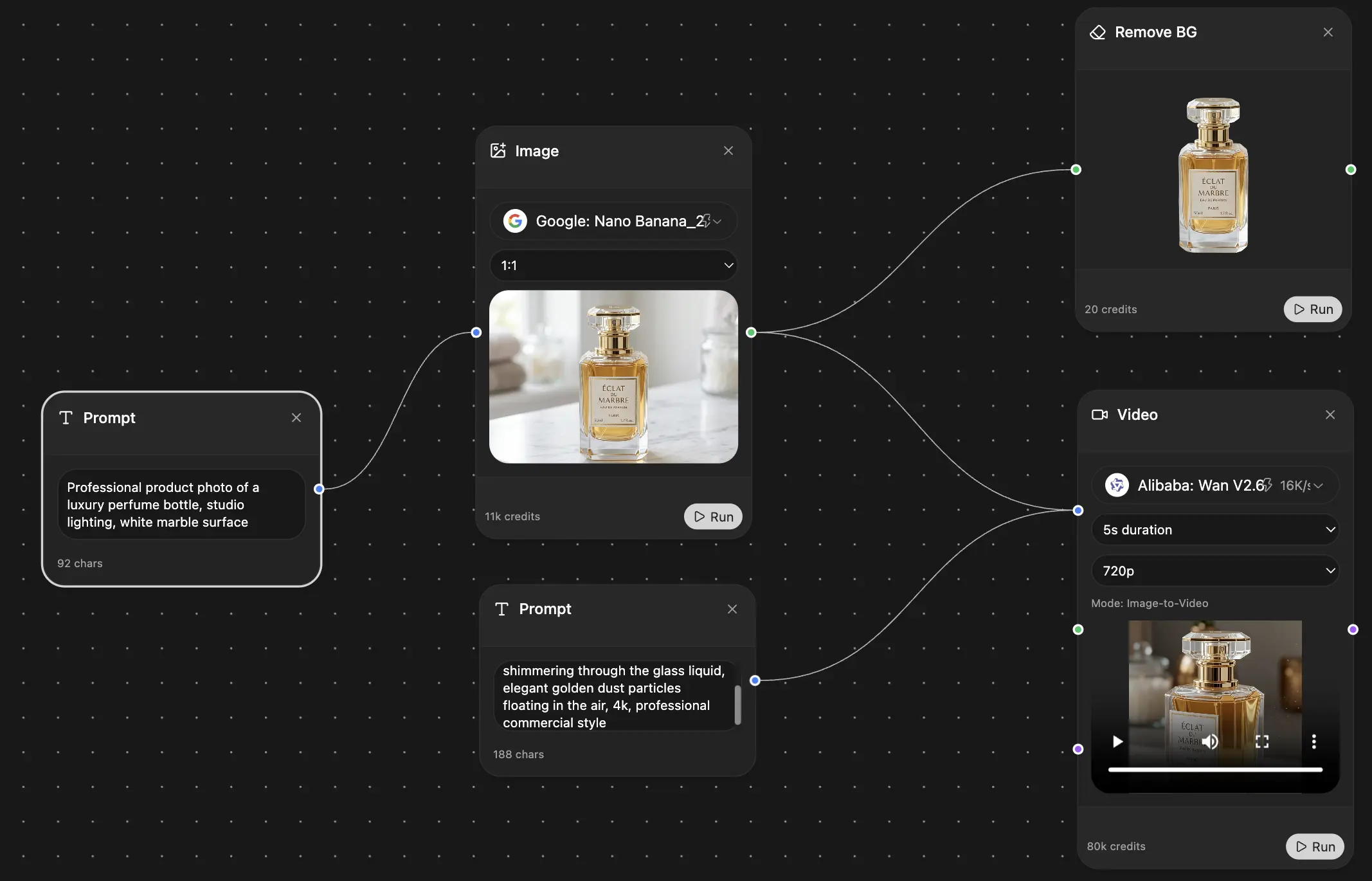
Your infinite AI canvas.
Chat, image, video & motion tools — side by side
Save hours of work and research
Transparent, High-Value Pricing
Trusted by teams at


Free
No credit card required
- 100 credits daily
- 3 AI models to try
- Basic AI chat
Plus
- 1,000,000 credits/month
- 25+ AI models — GPT, Claude, Gemini, Grok & more
- Agent Mode with web search, computer tools and more
- Creative Studio: image generation and video generation
- Project Library: chat with document, website and youtube, podcast generation, flashcards, reports and more
- Workflow Studio and FocusOS
Professional
- Everything in Plus, and:
- 2,100,000 credits/month
- Pro-exclusive models (Claude Opus, Grok 4, Sonar Pro)
- Motion Tools & Max Mode
- First access to latest features
- Access to additional offers
What Our Users Say
Great Tool after 2 months usage
"I love the way multiple tools they integrated in one platform. Going in the right direction."
— simplyzubair
Best in Kind!
"The quality of data and sheer speed of responses is outstanding. I use this app every day."
— barefootmedicine
Simply awesome
"The credit system is fair, models are perfect, and the discord is very responsive. Quite awesome."
— MarianZ
Great for Document Analysis
"Just works. Simple to use and great for working with documents. Money well spent."
— yerch82
Great AI site with accessible LLMs
"The organization of features is better than all the other sites — even better than ChatGPT."
— sumore
Excellent Tool
"It lives up to the all-in-one claim. All the necessary functions with a well-designed, easy UI."
— AlphaLeaf
Well-rounded platform with solid LLMs
"The team clearly puts their heart and soul into this platform. Really solid extra functionality."
— SlothMachine
Best AI tool I've ever used
"Updates made almost daily, feedback is incredibly fast. Just look at the changelogs — consistency."
— reu0691