


Every top model, with tools built in.
Search the web, run deep research, read files, create images and run code with GPT, Claude, Gemini, Grok and more.
Tired of losing brilliant ideas? Learn every method to convert ChatGPT to PDF, from simple browser tricks to advanced tools that will supercharge your workflow.
So you've had a mind-blowing chat with ChatGPT and now you need to save that stroke of genius. What's the plan? The quickest way is your browser's "Print to PDF" feature for a fast snapshot. You could also just copy and paste the text into a document. While these tricks work in a pinch, they can seriously mangle the formatting, especially with code blocks or those marathon chat sessions.
Let's be real, we've all been there. You have a total breakthrough session with ChatGPT, crack a huge problem, and then instinctively close the tab. And just like that… poof. It’s gone, lost to the digital void forever. That sinking feeling is exactly why learning how to convert ChatGPT to PDF isn't just a neat trick—it's an essential part of any smart workflow.
Saving your conversations is about more than just digital hoarding. It's about creating a personal, searchable library of your own best work and ideas. Seriously, your future self will thank you.
Think about these everyday situations:
By preserving these conversations, you're building a trail. You can track a project's evolution, document your research process, and create a searchable history of your best ideas. Getting a feel for understanding how AI chatbots function and the way they "think" really drives home the value of keeping these records.
This simple decision tree can help you decide when a conversation is worth keeping.
The flowchart brings up a critical point: archive it or let it go. Making that distinction is key to managing your knowledge effectively. In a world where ChatGPT saw 800 million weekly users by June 2025, tools for saving AI chats became indispensable.
Export features got a serious workout, with 14.5% of sessions tied to coding and another 14.1% for email composition—both perfect candidates for creating client-ready PDFs. A handy PDF export tool from PDFCrowd shows just how popular these use cases are.
Need a fast answer? Here are the top methods for converting your chats to PDF, from the simplest trick to the most powerful workflow.
Each method has its place, but the goal is to find what fits your workflow best.
While a basic PDF is a great starting point, platforms like Zemith can turn these static files into active project assets. Instead of just letting a chat collect digital dust in a folder, you can drop it right into a Zemith workspace. There, it becomes a dynamic, searchable part of your project's knowledge base. Building these habits aligns perfectly with the kind of document management best practices that keep your entire digital life organized.
Sometimes you don't need fancy tools or browser extensions. You just need a PDF of your ChatGPT conversation right now. These are the foundational, get-it-done methods that work on pretty much any computer. They aren't always pretty, but they are always reliable.
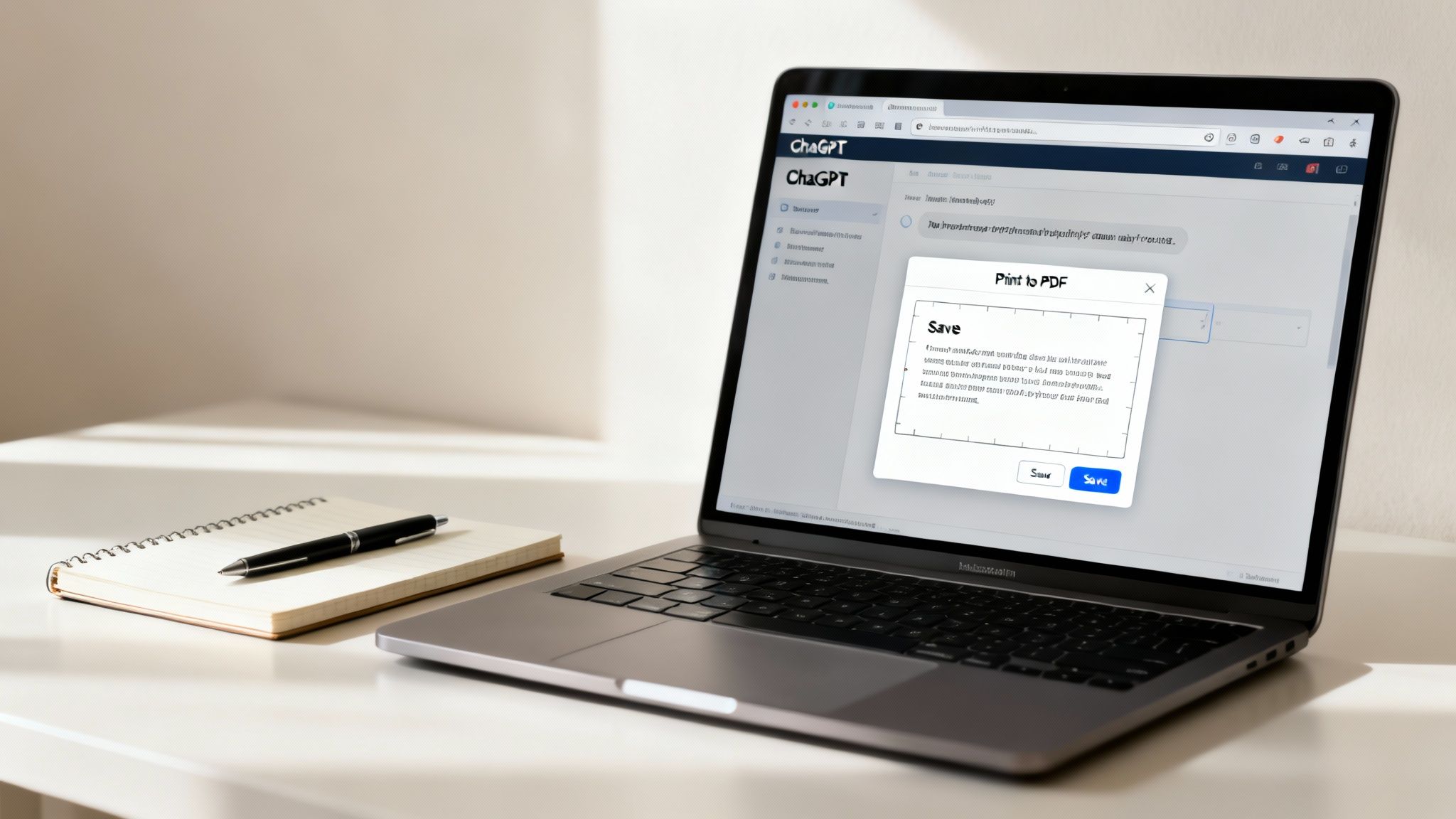
The most universal trick in the book is the good old "Print to PDF." Your browser has this feature built right in, and it’s your fastest path from a live chat to a shareable file. Just hit Ctrl+P (on Windows) or Cmd+P (on Mac) with your ChatGPT conversation on the screen.
A print dialog box will pop up. Instead of picking your office printer (save the trees!), look for a destination called "Save as PDF" or "Microsoft Print to PDF." This tells your computer to create a digital file instead of a physical piece of paper. Quick, simple, and effective.
Of course, there's always the classic copy-paste. It sounds almost too simple, but there's a right way and a wrong way to do it, especially if you're dealing with code blocks or other special formatting. I once sent my boss a PDF where a critical code snippet was a jumbled mess—a mistake I only made once.
To avoid that headache, paste your content into a proper word processor like Google Docs or Microsoft Word. These give you way more control over the final look.
When you're saving chats this way, knowing some basic document formatting principles goes a long way in making your PDFs clean and easy to read. These skills are also handy if you ever need to go the other way; our guide on how to convert a PDF to text covers how to pull information back out of your saved documents.
While these manual methods get the job done, they definitely show why a more integrated solution is helpful. For instance, pasting your chat into Zemith's Smart Notepad lets you instantly rephrase and polish the text before exporting, turning a raw conversation log into a professional asset without all the formatting gymnastics.
If wrestling with manual methods feels like churning butter by hand, browser extensions are the glorious, store-bought equivalent. They are fast, reliable, and built to do one thing exceptionally well: convert your ChatGPT conversations into a clean PDF with almost zero fuss. Forget the copy-paste gymnastics; these tools add a simple, dedicated button right into the ChatGPT interface.
Think of them as little specialists living in your browser. With a single click, they scan the entire conversation—even the parts you have to scroll to see—and package it up neatly. This is a total lifesaver for those long, threaded discussions that would otherwise be a nightmare to capture manually. The best ones are even smart enough to preserve tricky formatting for code blocks and embed images directly into the PDF.
Jumping onto the Chrome Web Store or Firefox Add-ons marketplace can feel a bit overwhelming. Don't just grab the first one you see. I've learned from experience that you need to look for a few key features that separate the good from the truly great.
A great extension doesn’t just save the text; it saves the context. It understands that a code block isn't just a paragraph and a user prompt isn't the same as an AI response, preserving the conversational flow that makes the chat valuable in the first place.
For instance, a popular choice like "ChatGPT to PDF" lets you export in multiple formats, while others are built for a minimalist, single-click experience. Once you find one you like, installation is a breeze—usually just a couple of clicks and you're good to go.
The big win here is pure efficiency. You save a conversation and can immediately get back to your work. But remember, this is still just an archiving step. To truly activate that information, you need a place to put it. This is where a platform like Zemith really shines. You can drop your newly exported PDF into a Zemith project, where it becomes a fully interactive asset. Suddenly, that static PDF is something you can chat with, summarize, or cross-reference with other project documents.
Think of it as the ultimate destination for your saved conversations, turning them from simple notes into a powerful knowledge base. You can explore some great organizational methods in our roundup of the best note-taking apps to see how this fits into a larger productivity system.
Saving a chat here and there is one thing, but what happens when you're constantly relying on ChatGPT and need a rock-solid way to archive those conversations? If you've ever thought, "There has to be a smarter way to do this," you're right. Automation is where the real magic happens.
This is for those who are ready to move beyond one-off saves and build a system that just works.
If you're comfortable with a bit of code, you can tap directly into the OpenAI API. Using a Python script, for example, you can programmatically fetch conversation data and generate perfectly formatted PDFs automatically.
This is the ultimate in control. You can build it directly into your own applications, create a custom backup tool that runs every night, or set up a system that sorts chats into specific folders based on their content. Total freedom.
But what if you don't write code? Does that mean you're stuck with manual methods? Absolutely not. This is exactly where integrated platforms come into play, offering all the power without the steep learning curve. There are some incredible AI workflow automation tools out there that handle all the technical details for you.
This is a problem Zemith was built to solve. Instead of you needing to write a Python script, you can use its built-in Coding Assistant to generate the code or simply connect your tools inside its workspace. It’s the power of automation, made accessible. Imagine automatically saving every single client brainstorming session into a specific project folder in the cloud. That's the kind of efficiency we're talking about.
It's important to remember that ChatGPT's job is to generate text; it doesn't create PDFs on its own. It's the tools we connect to it that handle the export. While developers use Python, a massive 18.9% of ChatGPT users are focused on academic research, where exporting to PDF is a daily task. With OpenAI projected to hit 1 billion users by the end of 2025, a smooth pipeline for saving this work is more critical than ever.
Whether you build it yourself or use a smart platform, automation is really about buying back your time. It’s the difference between being a manual filer and having a flawless digital assistant that does the work for you.
Ultimately, setting up an automated system for your chatgpt to pdf needs is an investment in scalability. You're freeing yourself from a repetitive chore and making sure those valuable insights are always saved, organized, and ready when you need them.
Saving a ChatGPT conversation as a PDF is a great start. You've grabbed a brilliant idea, archived a client chat, or saved a handy code snippet. But what if that static file wasn't the end of the line? What if it was just the beginning of a truly productive workflow?
That's the whole idea behind shifting from simply saving information to actively using it. Why let your best chats turn into digital paperweights when they can become living documents that actually work for you?
Picture this: you take that chatgpt to pdf file you just saved and drag it into Zemith's Document Assistant. All of a sudden, that flat document springs to life. Instead of just reading through it, you can now do so much more.
This completely changes what a PDF can be. It's no longer just a static record; it's an interactive partner you can query and learn from.
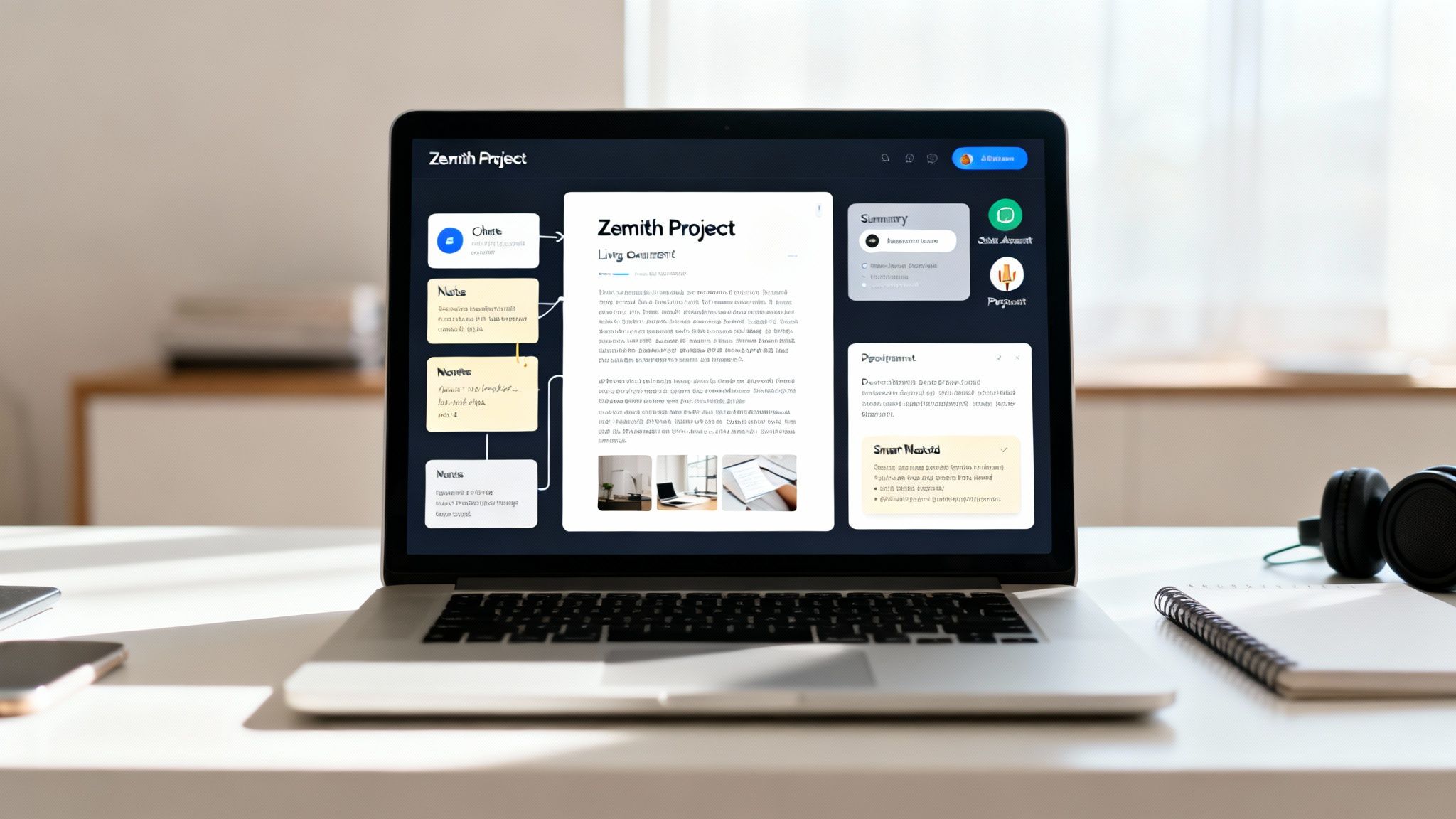
Let's be real—raw ChatGPT output usually needs a bit of polishing before you can share it. Instead of a clunky copy-paste-edit routine, you can use Zemith's Smart Notepad. Just drop your conversation in, and with a few clicks, you can rephrase awkward sentences, shift the tone for a professional audience, and transform the entire text into something client-ready.
The ability for AI to interact with documents has exploded. In mid-2025, ChatGPT's own PDF analysis features, running on the GPT-4o model, made huge waves. By the end of that year, document-related queries from paid users had jumped by a massive 250%. While impressive, tools like Zemith's Document Assistant take this a step further by building these interactive features into a single, cohesive workspace. For a deeper dive, you can check out more on this trend from DataStudios.org.
Your saved chats shouldn't go to a folder to die. They should become part of a centralized, searchable, and intelligent knowledge base that fuels your future work.
The real power move is to stop thinking in terms of individual files and start thinking about entire projects. Inside Zemith, you can set up a dedicated 'Project' for a specific client or topic. Every PDF, document, and chat you add becomes part of a shared knowledge hub for that one project.
This gives the AI full context. When you ask a question, it doesn't just look at one file; it pulls insights from everything in the project to give you a smarter, more complete answer. We've actually put together a full guide on how to use ChatGPT to summarize PDFs that gets into these more advanced techniques. This approach transforms your scattered AI conversations from simple archives into an organized, intelligent, and active part of your workflow.
Still have a few questions rolling around? You're not alone. When you start trying to turn a ChatGPT conversation into a clean PDF, a few common headaches tend to pop up. I've seen these questions come up time and time again, so let's get you some clear, straightforward answers.
One of the biggest hurdles I hear about is this: "Can I export a chat with images and code blocks correctly formatted?"
Yes, you absolutely can, but the method you pick makes all the difference. Relying on your browser's built-in 'Print to PDF' feature is a gamble—it often butchers code formatting or leaves images behind completely. For preserving the rich formatting of a chat, especially syntax highlighting in code, a dedicated browser extension is almost always your best bet.
If you need total control over the final look, your go-to move should be copying the conversation and pasting it into a tool like Zemith’s Smart Notepad. This gives you a sandbox to clean everything up, double-check your code blocks, and make sure every element is perfectly in place before you generate the PDF.
Then there's the issue of those marathon chats. "What's the best way to convert a really long ChatGPT chat to a PDF?"
For those epic, novel-length conversations, trying the 'Print to PDF' method can easily make your browser choke or even crash. A much more reliable approach is to use a browser extension designed to handle long scrolls, as it will properly paginate the content for you.
Alternatively, you can go old-school and manually copy and paste the conversation in chunks into a Google Doc or Word file. It takes a bit more effort, but it gives you complete control over page breaks and guarantees the final document is readable, not just one gigantic, unmanageable page.
A lot of people want to clean up their chats before saving them. So, "Is it possible to edit my conversation before saving it as a PDF?"
Absolutely! In fact, I highly recommend it if you want a polished, professional document. The copy-paste method is your friend here. Just drop the chat into your favorite word processor or, for a more integrated experience, into Zemith's Smart Notepad. From there, you can easily trim out the fluff, fix any typos, and even add your own notes. It’s how you turn a raw chat log into a genuinely useful asset.
Finally, and this is a really important one: "Are there privacy risks with using third-party extensions?"
It's smart to be cautious. When you install a third-party browser extension, you're essentially giving it access to the content on your page. My advice? Always stick to well-known extensions with a ton of positive user ratings and a crystal-clear privacy policy.
If your chats contain anything sensitive or confidential, the safest routes are always the manual ones—either using your browser’s print function or copying and pasting into a secure, offline editor.
Ready to stop just archiving chats and start putting them to work? Zemith is an all-in-one AI platform where you can save, organize, and even chat with your documents. Turn your static PDFs into interactive project assets and smooth out your entire workflow.


Trusted by teams at


The top models, plus image, video and voice tools, in one plan.
Without Zemith
ChatGPT PlusUS$20.00Claude ProUS$20.00Google AI ProUS$19.99SuperGrokUS$30.00Perplexity ProUS$20.00 MidjourneyUS$10.00
 ElevenLabsUS$6.00Le Chat ProUS$14.99
 RunwayUS$15.00Kling StandardUS$8.80
 Gamma PlusUS$12.00
 Otter ProUS$16.99
 QuillBot PremiumUS$19.95
 Photoroom ProUS$12.99
 Quizlet PlusUS$7.99
Total if paying separatelyUS$234.70/mo
"I love the way multiple tools they integrated in one platform. Going in the right direction."
— simplyzubair
"The quality of data and sheer speed of responses is outstanding. I use this app every day."
— barefootmedicine
"The credit system is fair, models are perfect, and the discord is very responsive. Quite awesome."
— MarianZ
"Just works. Simple to use and great for working with documents. Money well spent."
— yerch82
"The organization of features is better than all the other sites — even better than ChatGPT."
— sumore
"It lives up to the all-in-one claim. All the necessary functions with a well-designed, easy UI."
— AlphaLeaf
"The team clearly puts their heart and soul into this platform. Really solid extra functionality."
— SlothMachine
"Updates made almost daily, feedback is incredibly fast. Just look at the changelogs — consistency."
— reu0691
Hand off the research, writing, design and follow-ups. Zemith picks the tools it needs and brings back finished work.
Search the web, run deep research, read files, create images and run code with GPT, Claude, Gemini, Grok and more.
Zemith keeps working in the cloud and pings you when it's done.
Notion, Linear, Canva, Airtable and more. It asks before it creates or changes anything.
Docs, slides, sheets and PDFs, ready to send.
Chain models and tools on a visual canvas, from one prompt to a finished promo video.
Briefings, reports and reminders run on a schedule and are ready when you need them.
Real-time voice that can see your camera or screen.
The best image and video models, in one studio.
Turn PDFs, links and YouTube videos into podcasts, quizzes, flashcards and mind maps.


 Podcast
 Quiz
Quiz Flashcards
 Mind map
 Infographic