How to Use ChatGPT to Paraphrase: A Guide to Better Content That Doesn't Sound Like a Robot
Discover chat gpt paraphrase techniques to turn AI rewrites into natural, engaging content—prompts, tricks, and expert tips to boost quality.
You can absolutely use ChatGPT to paraphrase. A simple "Rewrite this for me" will get you an answer, but the real magic happens when you get specific. How you ask the AI to rewrite something is the difference between a clumsy synonym swap and a truly sophisticated rework of your text. It's like the difference between asking a chef to "make food" versus giving them a recipe for your grandma's legendary lasagna. One gets you fed, the other gets you a masterpiece.
Why Is Everyone Suddenly Talking About ChatGPT Paraphrasing?
Let's be real, "ChatGPT paraphrase" has become a massive buzzword. It’s the go-to for students, writers, and marketers, and it's lightyears ahead of those awful article spinners from back in the day. Remember those? The ones that would just swap out words until your content made about as much sense as a screen door on a submarine. Yeah, we've come a long way.

This new generation of AI isn't just about sidestepping plagiarism checkers; it’s about genuine transformation. It's that "Aha!" moment when a clunky, lifeless paragraph suddenly becomes clear, polished, and actually enjoyable to read. It's the digital equivalent of finding the perfect words you were searching for all along.
From Swapping Words to Understanding Meaning
The reason for all the hype is simple: modern AI gets the context. It doesn't just see a collection of words; it understands the intent behind them. That’s the secret sauce to a great paraphrase. You can tell it to:
- Switch up the tone: "Make this sound more professional and confident."
- Kill the complexity: "Explain this technical jargon like I'm a complete beginner."
- Adapt for a new audience: "Rewrite this as a casual social media post."
This ability to pick up on nuance is what makes it so powerful. It’s what separates a true writing assistant from a glorified thesaurus. This leap forward is all thanks to huge strides in conversational AI, which you can dive into deeper in our guide on .
The growth has been nothing short of astonishing. After its launch, ChatGPT rocketed to 1 million users in just five days. Fast forward to mid-2024, and an incredible 23% of consumers were using it specifically for writing and editing, proving just how essential paraphrasing has become.
It's Not Just a Tool for Writers
While marketers and content creators were the early adopters, its reach is far wider now. Students, for example, have found countless ways to integrate AI into their learning process. If you want to see how it's being used in academia, it’s worth checking out some of the available.
The real power of AI paraphrasing isn't just in rewriting—it's in unlocking clarity. It helps you find better ways to say what you mean, making it a creative partner, not just a content spinner.
And when you bring this capability into a tool like Zemith, you multiply its power. You're no longer stuck in a single chat window. You can manage entire projects, test your prompts across different AI models, and refine your work in a Smart Notepad—taking raw ideas to finished drafts all in one place. It’s a game-changer for anyone tired of juggling ten different tabs.
Crafting Your First Paraphrase Prompts
So, you're ready to start paraphrasing with ChatGPT. It’s easy to just dump your text in, type "rewrite this," and cross your fingers. And sometimes, that actually works! But more often, you get back something that just sounds… off. A little too robotic, a little too formal. You know the vibe.
The real trick to getting a great paraphrase isn't just about the AI—it’s about the instructions you feed it.
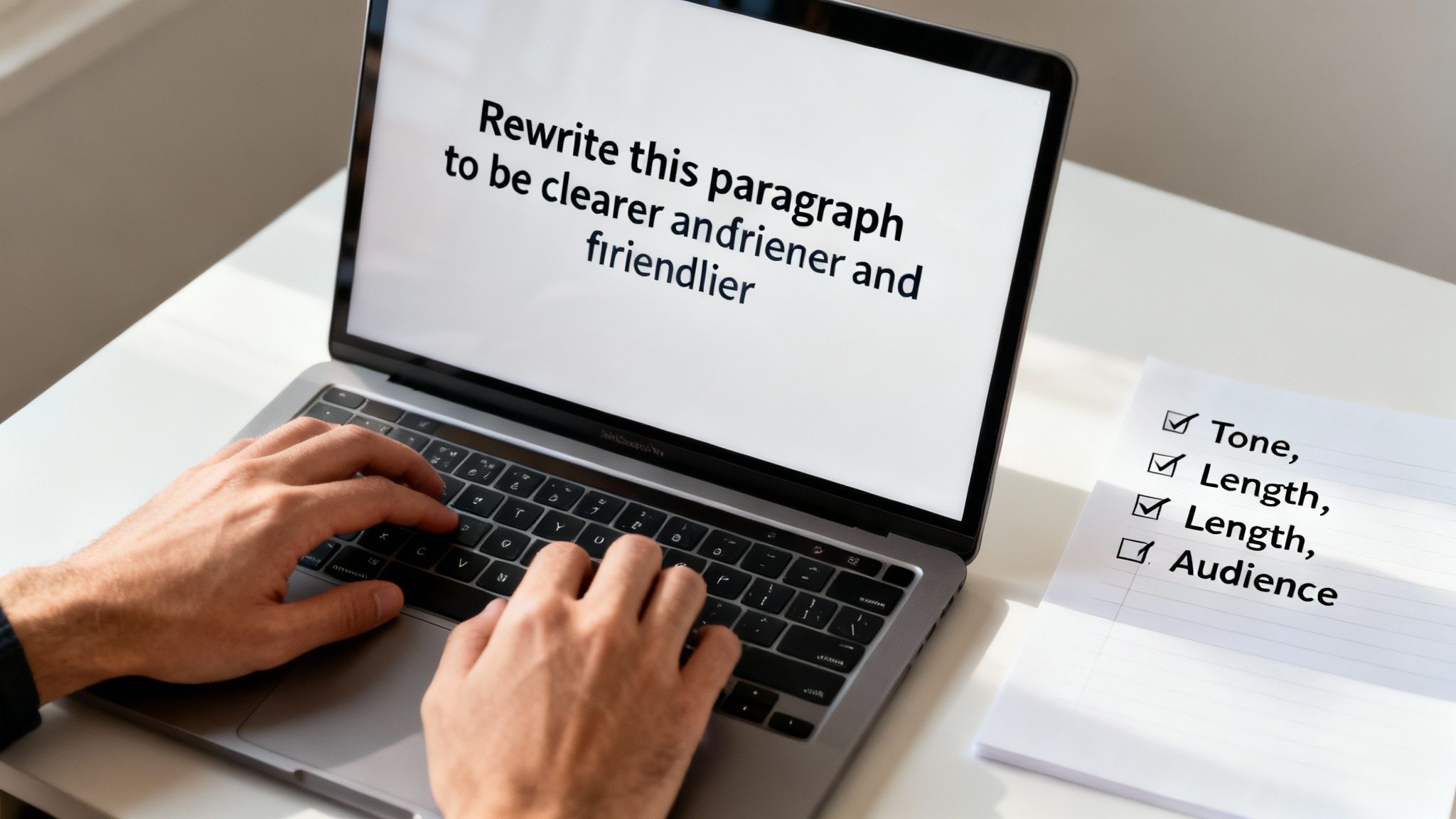
Think of it like this: you're the director, and the AI is your actor. A vague command like "act sad" might get you a droopy face, but it won't be a memorable performance. Now, if you say, "act like you just dropped your favorite coffee mug," you’ve given the actor a specific scenario to work with. That's where the magic happens.
The same idea applies here. Tiny, specific tweaks to your prompt can completely change the quality of the output.
The Basic Building Blocks of a Good Prompt
Your first attempts at using a chat gpt paraphrase tool will probably start with a few simple commands. These are your foundational tools, and each one has a specific job. The most common mistake I see is being too vague. Don't just say "change this." Get explicit about what kind of change you're after.
To get you started, here’s a quick-reference guide showing which simple prompt to use for different rewriting goals. It's a great way to choose the right command for your specific needs.
Basic Paraphrasing Prompts and When to Use Them
Picking the right starting command immediately points the AI in the right direction. It's the first step toward getting a result you can actually use without a ton of extra editing.
A Real-World Example: Before and After
Let's put this into practice. Imagine you're stuck with this sentence from a business report:
Original: "The utilization of our innovative synergy-driven methodologies has resulted in a substantial enhancement of our quarterly operational efficacy."
Yikes. It's a mouthful of corporate nonsense. If you just ask ChatGPT to "rewrite this," you might get something that's still pretty stuffy. We need to be more specific.
Prompt: "Paraphrase this sentence to sound clear and direct, for a non-expert audience. Avoid business jargon."
Now, watch what happens.
After: "Using our new methods helped us work much more effectively this quarter."
Big difference, right? Just by adding a little direction about the audience and tone, we got a much more human and useful result. This is the heart of effective prompting. If you want to go deeper on this, our guide on is a great place to build your foundation before we get into the more advanced stuff.
And if you’re working inside a tool like Zemith, this entire workflow becomes second nature. The Smart Notepad lets you instantly test these prompts, compare how different AI models handle them, and refine everything without ever leaving your document. No more copy-paste-panic.
Paraphrasing with Precision Using Advanced Prompts
Okay, so you've got the basics down. Now it's time to stop just asking the AI to "rewrite this" and start really conducting the orchestra. Advanced prompts are where you take the wheel, turning ChatGPT from a simple paraphraser into a precision tool that crafts text exactly the way you hear it in your head.
This isn't just about asking for a rewrite anymore; it's about giving surgical instructions. You can dictate the tone, the complexity, and even the exact vocabulary the AI uses. It’s the difference between getting a generic cover song and a completely fresh arrangement of your favorite tune.
Dialing in the Perfect Tone and Formality
One of the most powerful moves you can make is injecting a specific personality into the text. Let's be honest, the default AI tone can be a bit… bland. We can fix that.
Before you write your prompt, think about who this is for and what you want them to feel. Are you drafting an email to your boss or a caption for Instagram? The core message might be the same, but the delivery has to be completely different.
Here are a few templates I use to get the vibe right:
- For a casual, witty tone: "Paraphrase this to sound more conversational and witty, like something you'd find on a clever marketing blog. Keep sentences short and add a dash of humor."
- For a formal, executive audience: "Rewrite this for a C-suite executive. I need professional, direct language that focuses on key business outcomes. Cut all the casual stuff."
- For a total beginner: "Explain this like I'm five. Break it down into super simple steps and use an everyday analogy to make it stick."
Getting this right is a huge part of modern content creation. It's no wonder that 57% of content marketers now use AI mainly for drafting content, with a massive 71% calling it their go-to tool. Its ability to adapt a single piece of content for a blog, then social media, then an ad is what makes it so valuable. If you want to dive deeper into the numbers, the is worth a read.
Setting Constraints for Finer Control
Sometimes, what you don't want in a rewrite is just as important as what you do. Advanced paraphrasing is also about setting boundaries—telling the AI what to avoid. This is how you steer clear of overused corporate jargon, repetitive words, or phrases that just don't match your brand's voice.
The real art of prompt engineering is building a fence around the AI's creativity. You give it a defined space to play in, which ironically leads to more creative and useful results.
Think of it like handing a writer a style guide. You’re setting the rules of the game to get a much more refined and useful output.
Here’s an example prompt with constraints:
"Paraphrase the following paragraph.
Rules:
- The tone must be encouraging and supportive.
- Do not use the words 'leverage,' 'synergy,' or 'streamline.'
- Keep the final text under 75 words."
Adding these guardrails guides the AI toward a far more specific and intentional result. It’s a crucial skill for anyone who wants to master how an effectively.
Of course, typing out these complex prompts over and over again can be a real drag. That’s where a platform like Zemith makes a huge difference. Its Smart Notepad has built-in functions to change tone, formality, and length with just a click. You can apply these advanced techniques without manually writing a new prompt every single time. Plus, you can test your prompts across different models like GPT and Claude to see which one delivers the best rewrite for your needs, all in one place.
Navigating the Ethics of AI Paraphrasing
Let's get this out of the way, because it's the elephant in the room. Is using a chat gpt paraphrase tool just a fancy new way to cheat? Or worse, is it just plagiarism with extra steps? These are heavy questions, but we need to tackle them head-on.
Honestly, the answer isn't a simple yes or no. It really boils down to how you're using the tool. If you’re using AI to smooth out a clunky sentence or find a fresher way to say something complex, that’s just smart editing. But if you’re just copying, pasting, and letting the AI do all the real work without adding any of your own thought, you’re definitely stepping into a gray area.
The Launchpad vs. The Finished Product
Here’s how I like to think about it: AI-generated text is a launchpad, not the finished rocket. Its job is to give you a solid starting point, offer a new angle you hadn't considered, or help you bust through a nasty case of writer's block.
The final piece, however, has to be yours. That means weaving in your unique insights, your personal experiences, and your own critical thinking.
The real trap isn't the tool itself, but becoming totally dependent on it. When you let the AI take the wheel completely, your writing starts to sound generic and soulless. You lose your voice. Even more importantly, you rob yourself of the chance to actually get better as a writer.
The goal of AI paraphrasing should be to augment your intelligence, not replace it. If you're not contributing your own ideas and critical analysis, you're not writing—you're just curating.
This is a massive deal in academic settings. AI can be an incredible research assistant, but passing off its output as your own is a huge ethical no-go. If you're putting together a paper, it's worth checking out some expert to make sure you're using your sources and tools the right way.
A Simple Framework for Ethical AI Use
To stay on the right side of the ethical line, here's a simple framework I follow. It’s less about hard-and-fast rules and more about being intentional with your process.
- You Bring the Core Idea: The original thought, the argument, the data—that has to come from you. The AI is just helping you dress it up, not inventing it from scratch.
- You Fact-Check Everything: AI models are notorious for just making stuff up. You are 100% responsible for verifying every single fact, statistic, and claim that ends up in your final draft.
- You Inject Your Voice: Go through the AI's output with a fine-tooth comb. Add your own stories, analogies, and opinions. Ask yourself, "Does this actually sound like me?" If the answer is no, keep tweaking it until it does.
This conversation goes way beyond paraphrasing, too. It’s interesting to look at and see the parallels. The principle is the same: technology is just a tool, and it's the user's intent that makes it ethical or not. When you use a platform like Zemith that gives you access to multiple powerful models, that responsibility gets amplified. More power means you need to be more mindful.
Bring Your Rewriting Workflow into Zemith
Let’s be honest, juggling a dozen browser tabs and AI tools is a massive pain. You finally get the hang of prompt engineering and ethical guidelines, only to get bogged down by a clunky, inefficient process. It's time to stop the madness.
Instead of copying and pasting text back and forth, let's look at how you can weave these powerful AI techniques directly into your writing flow inside Zemith. This is about getting rid of the tab-switching chaos that absolutely murders creativity.
Meet the Smart Notepad
The core of this whole operation is Zemith's Smart Notepad. Picture it as your writing canvas and your AI co-pilot, all in one seamless interface. You can jot down your ideas, draft your content, and then run paraphrasing commands without ever leaving the document.
Got a messy list of bullet points that needs to become a smooth, flowing paragraph? There’s a built-in function for that. Need to flip the tone from buttoned-up corporate to friendly and casual? One click. It’s all the advanced prompting we’ve been talking about, just without the hassle.
This is the kind of ethical, human-in-the-loop workflow we’re aiming for, and it’s exactly what Zemith is built to do.
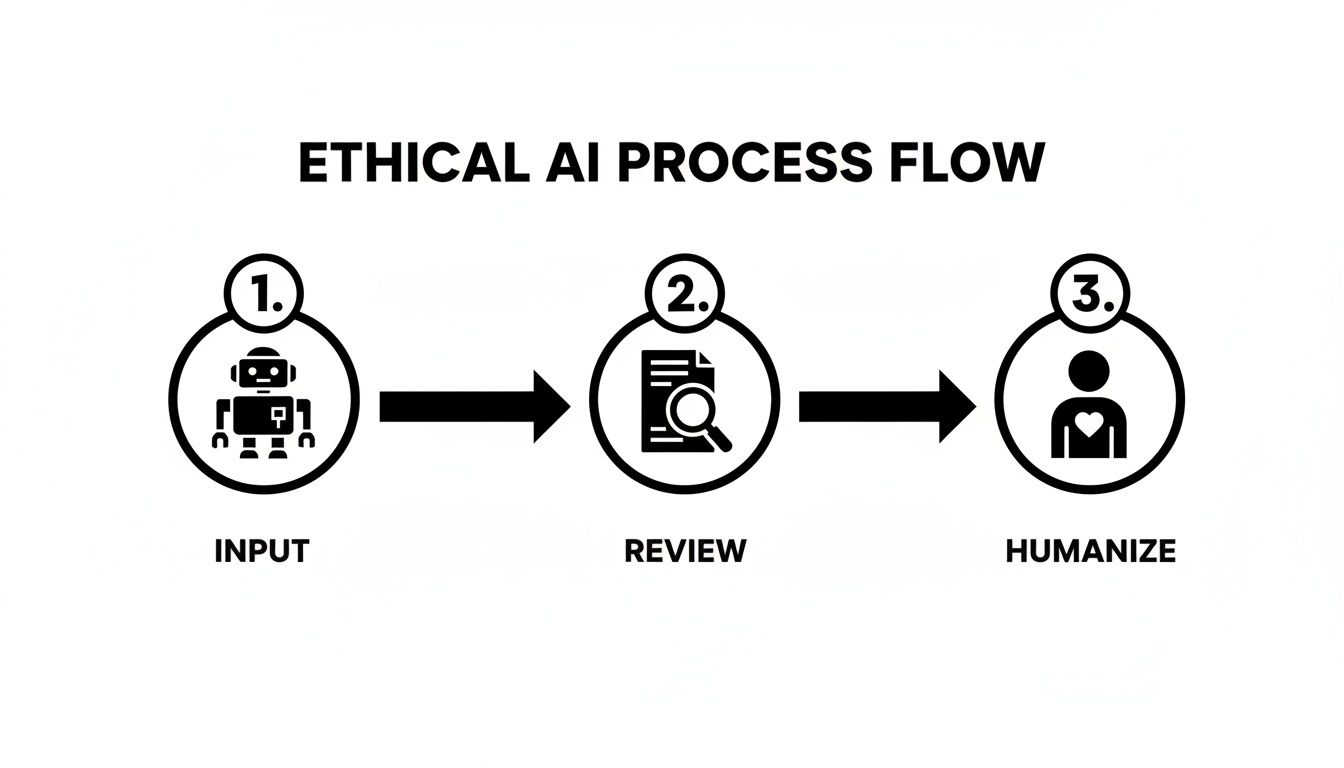
This process keeps you in the driver's seat, making sure the final output has your unique touch. It's no surprise that workflows like this are catching on. A recent study showed 35% of U.S. consumers now turn to ChatGPT for answers over traditional search, and 23% are already using it for rewriting tasks.
Inside Zemith, you get that same power—plus access to models like Claude and Gemini—all under one roof. It makes quick work of tasks like summarizing dense reports or even generating flashcards from your notes.
Test and Compare AI Models on the Fly
Have you ever found yourself wondering if Claude might give you a better rewrite than GPT-4 for a particular piece of text? Normally, you'd have to open two different chat windows, paste your content, and run the same prompt twice. It's tedious.
Zemith lets you test prompts across multiple AI models, right next to each other. This is a huge advantage for dialing in the perfect paraphrase. You’ll quickly learn which model nails your brand's witty tone and which one is better for straightforward, technical explanations.
With this multi-model setup, you can:
- Compare outputs side-by-side to see which AI gives you the best version.
- Dodge model bias by getting a few different "opinions" on your text.
- Pick the right tool for the job, every single time, without the guesswork.
The best writers don't just use tools; they use the right tools. Zemith puts an entire AI toolkit at your fingertips, letting you pick the perfect one for every sentence.
This isn't just about polishing existing text, either. It’s about creating better first drafts and speeding up the entire writing cycle. Being able to iterate quickly is what separates good content from great content. For a deeper dive into that idea, check out our guide on . By bringing everything into one place, you spend less time wrestling with tools and more time actually creating.
Got Questions About Paraphrasing with ChatGPT?
So, you're looking into how to use ChatGPT to paraphrase text, but a few questions are probably popping up. It's smart to be asking them. Let's dig into some of the most common concerns I hear.
Can AI Detectors Sniff Out Paraphrased Text?
The short answer? Sometimes. AI detection tools are getting pretty sophisticated, and if you just copy and paste what ChatGPT gives you, there's a good chance it could get flagged.
But that’s not really the right way to use these tools anyway. The trick is to stop thinking of the AI's output as the final product. It's just a starting point—a rough first draft.
Your job is to take that draft and make it human. Here’s how:
- Sprinkle in your own voice: Read it out loud. Does it sound like something you’d actually say? If not, tweak the wording.
- Share a real story: Nothing screams "human" like a personal anecdote or a specific, real-world example.
- Double-check the facts: AI models are notorious for confidently making things up. Trust, but verify.
When you collaborate with the AI this way, the final piece becomes yours. It's no longer just "AI content"; it's "AI-assisted content," and that's much harder for any tool to detect.
How Can I Stop the Paraphrased Text Sounding So... Robotic?
You've got to be a better director. A lazy prompt like "rephrase this" will get you an equally lazy, robotic response. You need to give the AI specific instructions on how you want it to sound.
Think of yourself as a film director giving an actor their motivation. Instead of a bland command, try giving it some personality:
- "Rewrite this but make it sound warm and friendly, like I’m explaining it to a buddy over coffee."
- "Paraphrase this paragraph to be more direct and punchy. Use short, crisp sentences."
Giving the AI stylistic guardrails is the secret sauce for getting writing that actually sounds like it was written by a person.
Is It Better to Paraphrase Sentence by Sentence or Whole Paragraphs?
This one’s a no-brainer: always feed the AI whole paragraphs or even entire sections. If you do it sentence by sentence, the AI is flying blind. It has zero context for what came before or what’s coming next. The result? A choppy, disjointed mess that feels completely unnatural.
Giving the AI the full context is like letting it see the whole puzzle before it starts placing the pieces. It helps maintain a consistent flow and logical structure, which is crucial for good writing.
Letting the model see the bigger picture will always give you a much smoother and more coherent rewrite.
Ready to stop juggling tabs and start paraphrasing efficiently? Zemith integrates all these advanced AI capabilities into a single Smart Notepad, letting you test models, refine your tone, and turn messy drafts into polished content faster than ever. and see the difference for yourself.
Explore Zemith Features
Every top AI. One subscription.
ChatGPT, Claude, Gemini, DeepSeek, Grok & 25+ more


Always on, real-time AI.
Voice + screen share · instant answers
What's the best way to learn a new language?
Immersion and spaced repetition work best. Try consuming media in your target language daily.
Voice + screen share · AI answers in real time
Image Generation
Flux, Nano Banana, Ideogram, Recraft + more

Write at the speed of thought.
AI autocomplete, rewrite & expand on command
Any document. Any format.
PDF, URL, or YouTube → chat, quiz, podcast & more
Video Creation
Veo, Kling, Grok Imagine and more

Text to Speech
Natural AI voices, 30+ languages
Code Generation
Write, debug & explain code
Chat with Documents
Upload PDFs, analyze content
Your AI, in your pocket.
Full access on iOS & Android · synced everywhere
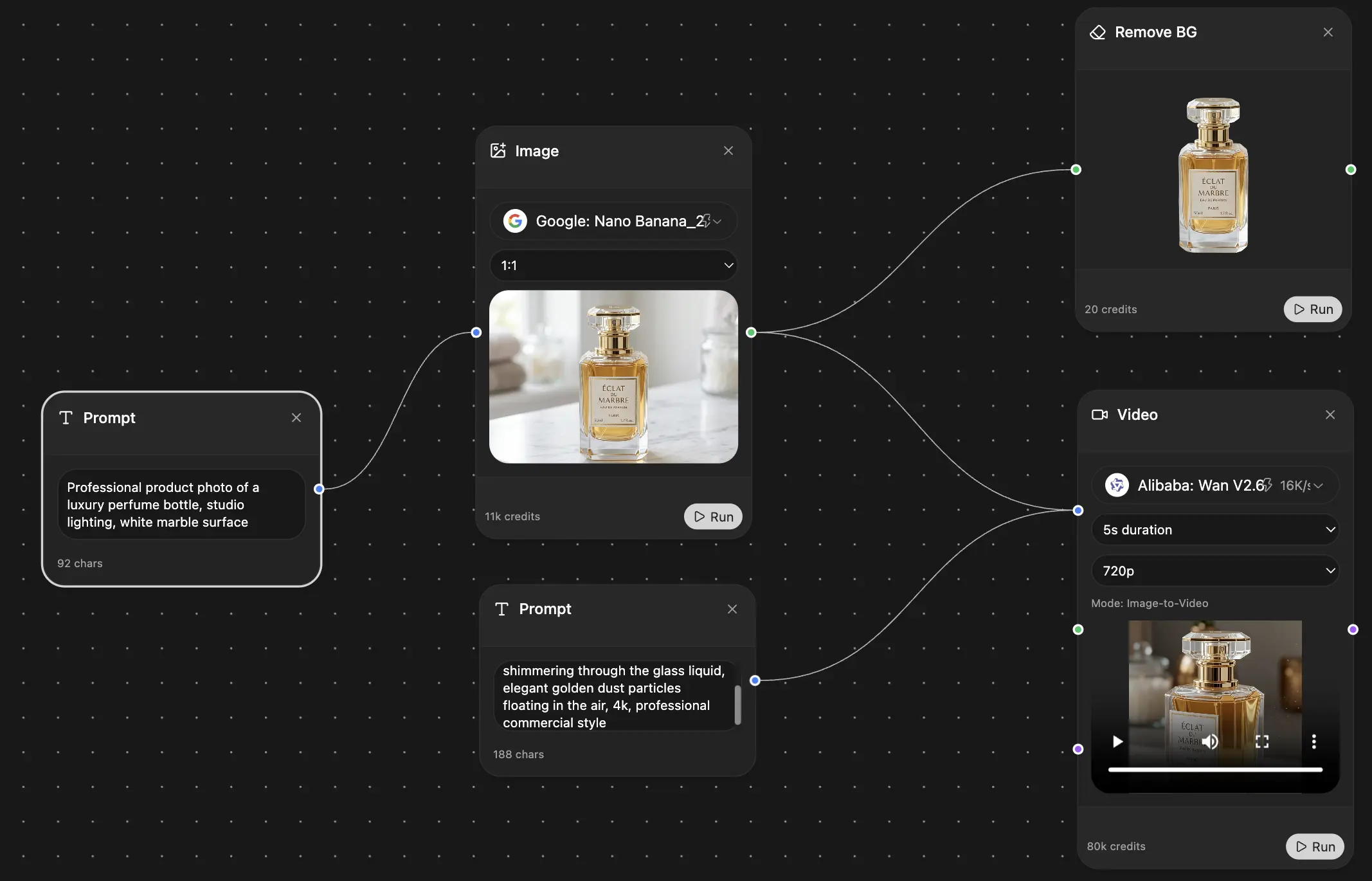
Your infinite AI canvas.
Chat, image, video & motion tools — side by side
Save hours of work and research
Transparent, High-Value Pricing
Trusted by teams at


Free
No credit card required
- 100 credits daily
- 3 AI models to try
- Basic AI chat
Plus
- 1,000,000 credits/month
- 25+ AI models — GPT, Claude, Gemini, Grok & more
- Agent Mode with web search, computer tools and more
- Creative Studio: image generation and video generation
- Project Library: chat with document, website and youtube, podcast generation, flashcards, reports and more
- Workflow Studio and FocusOS
Professional
- Everything in Plus, and:
- 2,100,000 credits/month
- Pro-exclusive models (Claude Opus, Grok 4, Sonar Pro)
- Motion Tools & Max Mode
- First access to latest features
- Access to additional offers
What Our Users Say
Great Tool after 2 months usage
"I love the way multiple tools they integrated in one platform. Going in the right direction."
— simplyzubair
Best in Kind!
"The quality of data and sheer speed of responses is outstanding. I use this app every day."
— barefootmedicine
Simply awesome
"The credit system is fair, models are perfect, and the discord is very responsive. Quite awesome."
— MarianZ
Great for Document Analysis
"Just works. Simple to use and great for working with documents. Money well spent."
— yerch82
Great AI site with accessible LLMs
"The organization of features is better than all the other sites — even better than ChatGPT."
— sumore
Excellent Tool
"It lives up to the all-in-one claim. All the necessary functions with a well-designed, easy UI."
— AlphaLeaf
Well-rounded platform with solid LLMs
"The team clearly puts their heart and soul into this platform. Really solid extra functionality."
— SlothMachine
Best AI tool I've ever used
"Updates made almost daily, feedback is incredibly fast. Just look at the changelogs — consistency."
— reu0691