


Every top model, with tools built in.
Search the web, run deep research, read files, create images and run code with GPT, Claude, Gemini, Grok and more.
Discover active learning strategies for students to boost engagement, retention, and grades with practical, results-driven tips.
Remember that one class where the clock seemed to move backward? You’re not alone. The human brain isn’t a sponge designed to just soak up information—it’s a muscle that needs a workout. That’s where active learning comes in. Forget passively listening; we’re talking about doing, discussing, and diving headfirst into the material. This isn't just a trendy educational buzzword; it's a fundamental shift from 'hearing about it' to 'figuring it out.'
This shift is crucial because active participation wires information into your brain more effectively than simply watching a presentation. When you actively grapple with concepts, you build stronger, more lasting neural connections. This isn't just beneficial for acing the next exam; it's about developing critical thinking and problem-solving skills that you'll use for the rest of your life. The core principles start early; to further explore the foundational benefits and approaches of active learning, consider this guide on active learning for kids, which shows how these methods build real confidence and agency from a young age.
In this guide, we’re about to break down 10 powerhouse active learning strategies for students that transform any learning environment from a silent movie into an interactive blockbuster. You’ll get a comprehensive look at methods like Think-Pair-Share, Problem-Based Learning, and the Jigsaw Method, complete with practical steps to implement them immediately. We'll cover everything from how to use active learning in college lectures to making study groups more effective. Get ready to turn your learning (or teaching) up to eleven, because passive is officially a thing of the past.
Ah, the classic Think-Pair-Share. If active learning strategies were a band, this would be the beloved, chart-topping hit single. Popularized by Frank Lyman back in the 80s, it’s a simple yet powerful three-step process that gets students moving from quiet reflection to collaborative discussion. Instead of the instructor posing a question and hearing only from the same three eager students, this method invites everyone into the conversation.
The magic is in its structure. First, students get a moment to Think on their own about a prompt. This quiet time is crucial; it allows for deeper processing without the pressure of an immediate public response. Then, they Pair up with a classmate to discuss their individual thoughts, refining their ideas and hearing a different perspective. Finally, pairs Share their combined insights with the larger group, leading to a richer, more diverse class discussion. It’s a fantastic way to turn passive listeners into active participants.
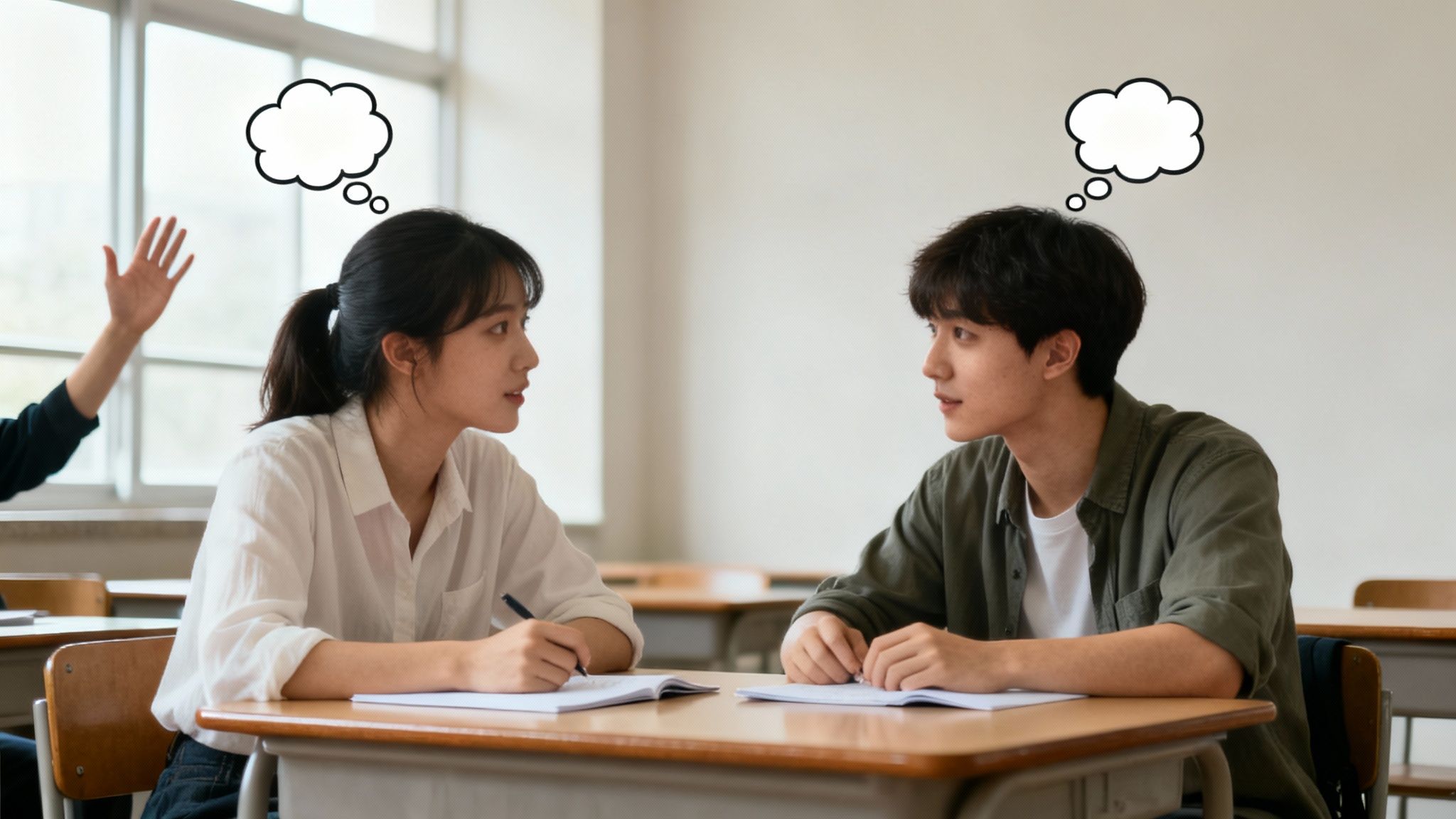
Ready to implement one of the most effective active learning strategies for students? Here’s how to nail it:
This strategy is incredibly versatile. In a science class, students can predict the outcome of an experiment. In a history class, they can debate the motivations of a historical figure. It works because it builds confidence, lowers the anxiety of speaking up, and ensures that more voices are heard.
If Think-Pair-Share is the hit single, then Problem-Based Learning (PBL) is the critically acclaimed concept album. Pioneered by medical educators like Howard Barrows in the 1960s, this approach flips the traditional "lecture first, problem second" model on its head. Instead of passively receiving information, students are thrown into the deep end with a complex, messy, real-world problem and must figure out what they need to learn to solve it.
The genius of PBL lies in its student-centered design. Students, typically in small groups, grapple with an authentic challenge first. This process forces them to identify knowledge gaps, conduct research, apply new information, and collaborate on a viable solution. It’s less about memorizing facts and more about learning how to learn, turning the classroom into a dynamic hub for investigation and discovery.
Ready to turn your students into investigative powerhouses? Here’s the blueprint for one of the most powerful active learning strategies for students:
PBL is a heavyweight champion of active learning. It excels at developing critical thinking, collaboration, and self-directed learning skills that are invaluable beyond the classroom walls. It transforms learning from a spectator sport into a full-contact, hands-on intellectual adventure.
Ever tried to explain a concept to a friend and suddenly understood it better yourself? That’s the core magic of Peer Instruction. Developed by Harvard physicist Eric Mazur, this strategy turns the classroom into a dynamic hub of collaborative sense-making. It’s a method that asks students not just what they think, but why they think it, and then challenges them to defend their reasoning to a peer.
The process is brilliantly simple but effective. An instructor poses a challenging conceptual question (often called a ConceptTest). Students first answer individually, usually with a clicker or polling software. Then, the real learning happens: they turn to a neighbor, find someone who answered differently, and try to convince each other of their own answer. After this lively debate, they vote again. More often than not, the percentage of correct answers skyrockets, not because of the instructor, but because students taught each other.
Ready to leverage the power of peer-to-peer learning? Here’s how to make Peer Instruction one of your go-to active learning strategies for students:
Peer Instruction is a powerhouse for developing reasoning skills. In a biology class, students might debate the mechanisms of cellular respiration. In a math course, they can argue over the most efficient problem-solving strategy. By requiring students to articulate and defend their ideas, you're not just teaching content; you're building a foundation for deep analytical abilities. This focus on argumentation is key; find out more about how to improve critical thinking skills and see how it connects.
If active learning strategies were a team-building exercise, the Jigsaw Method would be the trust fall that actually works. Developed by social psychologist Elliot Aronson in the 1970s, this cooperative learning strategy transforms students into a team of specialists who depend on each other to see the complete picture. It’s a brilliant way to break down complex topics and ensure every single student is an essential piece of the learning puzzle.
The process is ingenious. Students start in a "home group." Then, they break out into "expert groups," with each group assigned one specific part of the topic to master. Once they become experts, they return to their original home groups to teach their peers what they learned. This creates a classroom where students aren't just receivers of information; they are empowered teachers, responsible for their classmates' understanding. It’s one of the most effective active learning strategies for students because it promotes both individual accountability and group success.

Ready to turn your classroom into a powerhouse of peer-to-peer teaching? Here’s how to assemble the Jigsaw Method:
This method is incredibly adaptable. In a science class, expert groups can tackle different body systems. In a history class, they can each research a key cause of a major war. It excels at fostering deep understanding, communication skills, and a true sense of classroom community where every student’s contribution is vital.
If you've ever wanted to drop your students into the metaphorical deep end with a life jacket, Case Study Analysis is your go-to move. Pioneered by institutions like Harvard Business School, this method throws out abstract theories in favor of messy, real-world problems. Instead of just learning about concepts, students get to wrestle with a detailed account of a situation, playing the role of a decision-maker.
The core idea is to bridge the gap between knowing and doing. Students receive a "case," a narrative of a real or hypothetical scenario, and are tasked with dissecting it. They identify the key players, pinpoint the core issues, analyze the qualitative and quantitative data, and propose a viable solution. It’s an intellectual bootcamp that forces them to apply classroom knowledge to complex situations, transforming them from passive learners into active problem-solvers. This is one of the most powerful active learning strategies for students looking to develop critical thinking skills.
Ready to turn your students into expert analysts? Here’s how to make your case study session a success:
This strategy is incredibly adaptable. Business students can debate a company's market-entry strategy, medical students can diagnose a complex patient history, and law students can dissect a thorny legal precedent. It works because it develops analytical reasoning and decision-making skills in a practical, engaging context.
Ever wonder what’s actually sticking in your students' brains at the end of a long lecture? Instead of just hoping for the best, why not ask them directly? That's the genius behind Minute Papers and Reflection Prompts, a brilliantly simple technique championed by Thomas Angelo and Patricia Cross. This strategy is less of a pop quiz and more of a real-time feedback loop, giving students a moment to process what they've learned and providing instructors with invaluable insights.
The concept is simple: at the end of a lesson, you pose one or two targeted questions for students to answer in just a minute or two. This isn't about getting the "right" answer; it's about encouraging metacognition, that crucial skill of thinking about one's own thinking. It quickly transforms a passive audience into reflective learners, making it one of the most efficient active learning strategies for students looking to consolidate knowledge.

Ready to turn the last few minutes of class into a powerful learning tool? Here’s how to do it right:
This technique is a game-changer for gauging comprehension without the pressure of a formal grade. It helps students pinpoint what they know and what they still need to review, which is a massive step toward figuring out how to study more effectively. Whether you're teaching quantum physics or Renaissance art, a minute of reflection can make all the difference.
Ready for some intellectual fireworks? Debate and Structured Controversy turns the classroom into an arena of ideas, asking students not just to learn information but to champion a viewpoint. This strategy moves beyond simple discussion by requiring students to research, structure, and defend an argument, often from a perspective they don't personally hold. It's a powerful exercise in critical thinking, empathy, and persuasive communication.
The core idea, particularly with the "structured controversy" model developed by David W. and Roger T. Johnson, is to get students to understand an issue from multiple angles. Students are assigned opposing sides of a topic, present their best case, listen to the opposition, and then work collaboratively to find common ground or synthesize a new, more nuanced position. This process teaches them that complex issues rarely have simple, black-and-white answers. It's one of the most dynamic active learning strategies for students looking to sharpen their analytical skills.
Looking to spark some lively and respectful argumentation? Here's how to set up a successful debate:
This strategy is a knockout in a political science class for debating policy, an English class for arguing different literary interpretations, or even a science class for presenting the evidence for competing theories. It teaches students to listen actively, think on their feet, and appreciate the complexity of an issue.
Ready to move beyond hypotheticals and into hands-on practice? Simulation and role-playing are where learning gets real, fast. These immersive strategies drop students directly into scenarios that mimic real-world situations, asking them to take on a role and make decisions with tangible (though simulated) consequences. Instead of just reading about a historical negotiation or a business dilemma, students live it.
The power of this method, championed by experiential learning experts like Mel Silberman, is its ability to bridge the gap between theory and application. Students aren't just memorizing facts; they are actively applying knowledge, testing hypotheses, and developing critical soft skills like communication, negotiation, and empathy. From a mock trial in a civics class to managing a virtual company in a business course, it’s one of the most dynamic active learning strategies for students available.
Looking to create a truly memorable learning experience? Here’s how to set up a successful simulation:
This strategy is perfect for complex topics where decision-making is key. It allows students to experience the weight of their choices in a safe environment, making abstract concepts concrete and unforgettable.
They say the best way to learn something is to teach it. This strategy takes that old adage and runs with it, turning students into instructors. Popularized by researchers like Annemarie Sullivan Palincsar, reciprocal teaching is a structured dialogue where students take turns leading the discussion using four key comprehension strategies. It’s a powerful method that moves beyond simple peer tutoring into a more dynamic, collaborative learning experience.
The core idea is simple but profound. Instead of passively receiving information, students are actively engaged in making sense of it for their peers. The reciprocal teaching model, for example, guides students through predicting what will happen next, questioning confusing parts, clarifying difficult concepts, and summarizing the main ideas. This process doesn't just transfer knowledge; it builds deep comprehension, metacognitive skills, and a sense of shared ownership over the learning process.
Ready to empower your students to become teachers? Here’s how to effectively implement this active learning strategy:
This strategy is a game-changer for reading comprehension in a literature class or for breaking down complex theories in a social studies course. By putting students in the driver's seat, you’re not just teaching them content; you’re teaching them how to learn.
If Think-Pair-Share is the hit single, Project-Based Learning (PBL) is the epic, full-length concept album. This isn't a one-and-done activity; it's an extended instructional journey where students explore a complex question or challenge over weeks or even a whole semester. With roots in John Dewey's philosophy of experiential education, PBL turns the traditional classroom model on its head. Instead of learning content first and then doing a project, the project itself is the vehicle for learning.
The core idea is to engage students in solving an authentic, real-world problem. They don't just memorize facts; they conduct research, collaborate, create tangible products, and present their findings. It’s a powerful method that builds not only deep content knowledge but also critical thinking, creativity, and project management skills. This is one of the most comprehensive active learning strategies for students because it mirrors how work gets done in the real world.
Ready to launch a learning adventure? Here’s your blueprint for success with PBL:
PBL is incredibly adaptable. A science class could tackle a local sustainability issue, an English class could produce a documentary on a social justice topic, and a business class could develop a marketing plan for a local non-profit. It thrives by transforming students from passive information consumers into active creators and problem-solvers.
Well, you've made it to the end! We've just navigated a whirlwind tour of ten powerful active learning strategies for students, from the quick and collaborative Think-Pair-Share to the deep, immersive worlds of Project-Based and Problem-Based Learning. We've seen how these methods transform learning from a spectator sport into a full-contact, hands-on experience. The days of passively highlighting a textbook until it turns into a neon mess are officially over.
The core takeaway isn't that you need to become a master of all ten strategies by sunrise tomorrow. That's a recipe for burnout, not breakthrough. Instead, view this list as your personal toolkit. The real magic happens when you stop just reading about them and start doing them. The journey from passive observer to active participant is the single most important leap you can take in your educational or professional development.
Feeling overwhelmed by the options? Let’s make it simple. Your challenge, should you choose to accept it, is to pick just one strategy and integrate it into your routine this week.
The goal is to build momentum. Mastering these active learning strategies for students is a marathon, not a sprint. Each small experiment builds confidence and rewires your brain to engage more deeply with information, leading to knowledge that actually sticks.
Ultimately, active learning is about more than just better grades or acing a presentation. It's about developing the critical thinking, problem-solving, and collaborative skills that are non-negotiable in today's world. Whether you're a student building a foundation, a developer debugging complex code, or an entrepreneur navigating a new market, the ability to actively engage with challenges is your superpower.
It's the difference between knowing a fact and understanding a system. And as you continue to build these skills, finding resources that support your journey is crucial. For additional general educational resources and insights that can support teaching practices, you might also want to explore schooleads for educational resources.
The strategies we've covered, from Case Study Analysis to Simulation, are designed to make you a better thinker, a more effective collaborator, and a more confident owner of your own knowledge. You're not just learning material; you're learning how to learn, a skill that will pay dividends for the rest of your life. So go ahead, pick your starting point, and get your hands dirty. Your future, more engaged self will thank you for it.
Ready to supercharge your active learning process? Zemith is your all-in-one AI workspace designed to help you research, write, and create more efficiently. Stop juggling a dozen apps and start using a single, powerful tool to analyze data for your case studies, generate ideas for your projects, and bring your learning to life. Try Zemith today and turn your active learning strategies into tangible results.


Trusted by teams at


The top models, plus image, video and voice tools, in one plan.
Without Zemith
ChatGPT PlusUS$20.00Claude ProUS$20.00Google AI ProUS$19.99SuperGrokUS$30.00Perplexity ProUS$20.00 MidjourneyUS$10.00
 ElevenLabsUS$6.00Le Chat ProUS$14.99
 RunwayUS$15.00Kling StandardUS$8.80
 Gamma PlusUS$12.00
 Otter ProUS$16.99
 QuillBot PremiumUS$19.95
 Photoroom ProUS$12.99
 Quizlet PlusUS$7.99
Total if paying separatelyUS$234.70/mo
"I love the way multiple tools they integrated in one platform. Going in the right direction."
— simplyzubair
"The quality of data and sheer speed of responses is outstanding. I use this app every day."
— barefootmedicine
"The credit system is fair, models are perfect, and the discord is very responsive. Quite awesome."
— MarianZ
"Just works. Simple to use and great for working with documents. Money well spent."
— yerch82
"The organization of features is better than all the other sites — even better than ChatGPT."
— sumore
"It lives up to the all-in-one claim. All the necessary functions with a well-designed, easy UI."
— AlphaLeaf
"The team clearly puts their heart and soul into this platform. Really solid extra functionality."
— SlothMachine
"Updates made almost daily, feedback is incredibly fast. Just look at the changelogs — consistency."
— reu0691
Hand off the research, writing, design and follow-ups. Zemith picks the tools it needs and brings back finished work.
Search the web, run deep research, read files, create images and run code with GPT, Claude, Gemini, Grok and more.
Zemith keeps working in the cloud and pings you when it's done.
Notion, Linear, Canva, Airtable and more. It asks before it creates or changes anything.
Docs, slides, sheets and PDFs, ready to send.
Chain models and tools on a visual canvas, from one prompt to a finished promo video.
Briefings, reports and reminders run on a schedule and are ready when you need them.
Real-time voice that can see your camera or screen.
The best image and video models, in one studio.
Turn PDFs, links and YouTube videos into podcasts, quizzes, flashcards and mind maps.


 Podcast
 Quiz
Quiz Flashcards
 Mind map
 Infographic